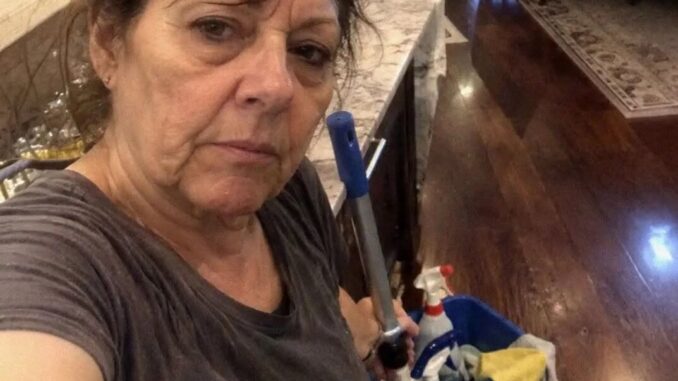
I spent eight years entering Mrs. Whitaker’s home with a key of my own, yet I still asked before taking a glass from her cabinet.
That boundary had always made sense to me.
Until the day she asked me to come back when there was nothing left to clean.
When Mrs. Whitaker told me to return without my cleaning supplies, I assumed she had old dishes, clothes, or furniture she wanted me to take.
I even cleared out the backseat of my car.
I had no idea that what she wanted to give me couldn’t be packed into a box.
Eight Years of Thursday Mornings
For eight years, I cleaned Mrs. Whitaker’s house every Thursday.
I knew which kitchen drawer stuck, which towels were reserved for guests, and exactly where every picture frame belonged after I dusted it.
She knew me as Carly, the woman who arrived at nine and usually finished before two.
At least, that was how I believed she saw me.
Mrs. Whitaker was never rude.
She always paid on time. She left the air-conditioning running when she went out, and she regularly asked how my daughter, Willa, was doing.
Still, we weren’t friends.
I had a key to her house, but I continued asking before taking a glass of water.
When I first began working for her, Willa was nine years old.
I had recently separated from her father and was trying to schedule enough cleaning jobs between school drop-off and pickup to support us.
Mrs. Whitaker had found one of my handwritten advertisements and called me.
That Thursday cleaning appointment quickly became the one job I knew I could count on.
Then Mrs. Whitaker Told Me She Was Moving
A few weeks ago, Mrs. Whitaker told me she was moving closer to her daughter, Mara.
“I’m tired of having a whole upstairs I don’t use,” she joked.
We both laughed.
But cleaning her house for the final time was harder than I expected.
There were pale rectangles on the walls where family photographs had hung. Her kitchen calendar was gone. Several rooms were almost empty.
I kept reaching to move things that were no longer there.
When I finished, I handed Mrs. Whitaker my key.
Instead of taking it, she closed my fingers around it.
“Not yet,” she said. “Come back Saturday at eleven.”
“Do you need me to clean after the movers?”
“No. And leave your supplies at home.”
I must have looked confused.
“I’m asking you to visit, Carly.”
That was different.
I Still Thought She Wanted to Give Me Something
On Saturday, I arrived wearing jeans without bleach stains and a blouse I usually saved for school events.
I also brought cookies because arriving empty-handed felt strange.
Most of the furniture was already gone, but Mrs. Whitaker had kept the kitchen table and two chairs.
There were sandwiches waiting on real plates.
“Sit down,” she said. “I know you usually eat lunch in your car.”
I stopped.
I hadn’t realized she knew that.
We talked about her move and Willa’s senior year.
When we finished eating, I automatically began stacking the plates.
Mrs. Whitaker reached across the table.
“Leave those. There’s something I want to show you.”
She disappeared into the living room and returned carrying a cardboard box.
I glanced through the front window at my empty backseat.
Apparently, I had guessed correctly.
“If those are dishes, I’ve got plenty of room,” I said.
“Dishes?”
“Or clothes. Whatever you’re trying to get rid of.”
For a moment, she simply looked at me.
Then she laughed.
“Oh, Carly.”
The Box Was Full of Something Completely Different
Mrs. Whitaker placed the box on the table.
Inside were photographs, greeting cards, envelopes, and folded letters collected over many years.
“You want help sorting these?” I asked.
“No.”
It was already the second time that afternoon I had tried to turn the visit into work.
Mrs. Whitaker pulled out a Christmas card and handed it to me.
The photograph showed her daughter, Mara, with her husband and children.
I had seen their pictures around the house for years.
“Open it,” she said.
I did.
Underneath the printed greeting was a handwritten note.
I skimmed it until one sentence stopped me.
“Tell Carly I hope Willa likes middle school. Tell her I said the first month is always the worst.”
I looked up.
“Why am I in Mara’s Christmas card?”
Mrs. Whitaker reached back into the box.
The next card was from several years later.
Near the bottom, Mara had written:
“Did Willa ever get comfortable driving? Tell Carly I remember teaching Kellen, and I still haven’t recovered.”
I read it twice.
“She knew Willa was learning to drive?”
“You told me about it.”
“I told you.”
“Yes.”
“But you told her?”
Mrs. Whitaker shrugged.
“Apparently.”
My Name Was Everywhere
I began looking through the cards myself.
Birthday cards. Christmas cards. Mother’s Day notes.
My name wasn’t in every one, but it appeared enough that I could feel my face getting warm.
“Ask Carly if Willa got that summer job.”
“Tell Carly congratulations about Willa’s grades.”
Another note asked whether my back had improved after I strained it moving a client’s dining table.
Mrs. Whitaker’s family couldn’t have known those things unless she had talked about me.
Then I found another card.
“Is Thursday still Carly’s day? I know you like having someone there.”
I looked across the table.
“What does that mean?”
Mrs. Whitaker lowered her eyes.
“What?”
“Mara knew what day I cleaned your house?”
“She knew you came Thursdays.”
“Why?”
Mrs. Whitaker hesitated.
“After George died, she called more often.”
I Remembered Those Thursdays After George Died
George, Mrs. Whitaker’s husband, died during my fourth year cleaning their home.
Afterward, his shoes disappeared from the mudroom.
His coffee mug vanished from beside hers.
But his chair in the living room remained exactly where it had always been.
For months, I dusted around it.
Mrs. Whitaker changed too.
Before George died, she often went grocery shopping or met friends while I cleaned.
Afterward, she was home almost every Thursday.
I assumed she simply had nowhere else she needed to be.
“She worried about me,” Mrs. Whitaker explained. “Mara wanted me to move closer to her even then. I wouldn’t.”
“So you told her I was here?”
“Sometimes.”
“Why?”
She paused before answering.
“Carly, there were weeks after George died when you were the only person I knew for certain was going to walk through that door.”
The house suddenly felt very quiet.
I Had Never Understood What Those Conversations Meant
I thought about all those Thursdays.
Mrs. Whitaker making coffee at 1:30 when I was nearly finished.
Her appearing in whatever room I happened to be cleaning.
“How is Willa liking high school?”
“Did your car ever stop making that noise?”
“Are you working over Thanksgiving?”
I always answered while folding towels or wiping countertops.
I never thought those conversations were important.
“I didn’t know,” I said.
“I didn’t want you to.”
“Why?”
She looked almost surprised.
“Because you worked for me.”
“So?”
“You had to be here.”
I started to respond, but she continued.
“You were supporting your daughter. You had other houses to clean after mine. You watched the clock because you had school pickup. I knew that.”
Then she said something I will never forget.
“I was lonely, Carly. But that didn’t give me the right to make my loneliness part of what I was paying you to manage.”
Something tightened behind my eyes.
We Had Both Been Protecting the Same Boundary
For eight years, I believed our boundaries were simple.
I worked.
She paid me.
We liked each other.
That was all.
Now I remembered things differently.
During one terrible storm, Mrs. Whitaker had insisted I wait before driving home.
We stood in the kitchen talking while rain hammered against the windows.
Another Thursday, she had baked too much banana bread and somehow had an entire loaf wrapped for me before I left.
After George died, she sometimes looked disappointed when I finished early.
I had convinced myself I was imagining it.
“Why didn’t you ever tell me?” I asked.
“I just did.”
“No. Why didn’t you tell me I mattered to you?”
Her expression softened.
“Because I didn’t know whether I mattered to you.”
I almost laughed.
“Mrs. Whitaker, I knew your guest towels.”
She smiled.
“That’s your argument?”
“I knew you hated lemon-scented cleaner. I knew that kitchen drawer had to be lifted before it would close. I knew you kept George’s chair in the same place for months.”
Her smile disappeared.
“I knew when you were having a difficult day before you said anything.”
She was quiet for a moment.
Then she asked, “So why did you always eat lunch in your car?”
Suddenly, I Had to Explain My Own Boundaries
“I needed a break,” I said.
“You couldn’t take your break at my table?”
I looked at the plates sitting between us.
“I didn’t want to get too comfortable.”
“Why?”
When I first started cleaning houses, I needed every job I could find.
Some clients were very particular about boundaries.
I never wanted anyone thinking I was helping myself to their food, wasting paid time, or treating their home like my own.
“But you knew I wasn’t like that,” Mrs. Whitaker said.
“After a while, yes.”
“Yet you still asked before getting water.”
“You noticed that?”
“Carly, I wasn’t unconscious for eight years.”
I laughed even though my eyes were burning.
“I guess I didn’t want you thinking I was taking advantage because you were nice to me.”
Mrs. Whitaker nodded.
“And I didn’t want you thinking I was taking advantage because I paid you.”
We stared at each other.
Then the ridiculous truth became obvious.
For eight years, we had been protecting the same boundary from opposite sides.
I had mistaken her restraint for proof that I was only an employee.
She had mistaken mine for proof that I wanted to remain one.
That Was Why She Invited Me Back on Saturday
“That’s why Saturday?” I asked.
“That’s why Saturday.”
She gestured toward the nearly empty kitchen.
“You finished Thursday. I paid you. The movers are coming Monday. You don’t work for me anymore.”
The sentence hurt more than I expected.
Mrs. Whitaker must have noticed.
“I needed one day when there was nothing for you to clean and nothing I could pay you for.”
I looked around.
The sandwiches.
The plates she wouldn’t let me clear.
The chair she had made me sit in.
My cleaning supplies sitting at home.
Everything had been deliberate.
“So what did you want?” I asked.
For the first time that afternoon, Mrs. Whitaker looked nervous.
She folded the corner of a napkin between her fingers.
“When I move, would you call me sometimes?”
I stared at her.
“That’s it?”
She looked embarrassed.
“Not every day. I know you have a life. Maybe once in a while. Or I could call you.”
“Mrs. Whitaker.”
“And if you’re ever near my new place, perhaps we could have lunch.”
“Mrs. Whitaker.”
“What?”
I started laughing.
She frowned.
“I don’t see what’s funny.”
“I emptied my entire backseat.”
Her mouth twitched.
“I wore my good blouse.”
“I noticed.”
“I thought you were giving me half your kitchen.”
That made her laugh too.
“Because I Want To”
By the time we stopped laughing, I was wiping tears from my cheeks.
And I wasn’t entirely sure they were all from laughter.
“I’ll call you,” I said.
Something changed in her face.
Not dramatically.
Mrs. Whitaker was never dramatic.
But something softened.
“Because you want to?”
That question mattered.
So I answered carefully.
“Because I want to.”
We sat there for another hour.
For once, I didn’t check the time.
I Finally Gave Her Back the Key
When I eventually stood to leave, I reached into my purse and found the key she had made me keep on Thursday.
I placed it on the kitchen table.
Mrs. Whitaker looked at it but didn’t touch it.
That small brass key had allowed me into her home for eight years.
Leaving it behind felt like closing one chapter of my life.
Then I noticed a blank notepad near the place where her kitchen calendar had once hung.
I picked up the pen and wrote down my personal phone number.
Mrs. Whitaker watched as I tore off the sheet.
“You already have my work number,” I told her. “That’s the number you call when you don’t need your house cleaned.”
She smiled.
“I’ll try not to abuse the privilege.”
“Good.”
I pushed the cookies I had brought toward her.
“Keep those too.”
“You’re leaving me quite a lot.”
I looked at the family cards spread across the table and my old key lying beside them.
“No,” I said. “I think you’ve already given me enough.”
I Finally Understood What She Had Given Me
Outside, I opened my car and looked at the empty backseat.
I had cleared it because I was convinced Mrs. Whitaker wanted to give me something before she moved.
I had been right.
I just hadn’t understood what she was giving me.
For eight years, I walked into her home every Thursday believing I knew exactly where I stood.
I knew where the guest towels belonged.
I knew how to close the stubborn kitchen drawer.
I knew where every picture frame went after I dusted it.
What I didn’t know was that somewhere along the way, my name had found a place in that house too.
And finally, I understood why Mrs. Whitaker had asked me to come back without my cleaning supplies.
She needed me to walk through her door once when neither of us owed the other anything.
So whatever came afterward could be something we both chose.
Do you think Carly and Mrs. Whitaker were right to keep such firm boundaries, or did those boundaries prevent them from understanding each other sooner?
Leave a Reply