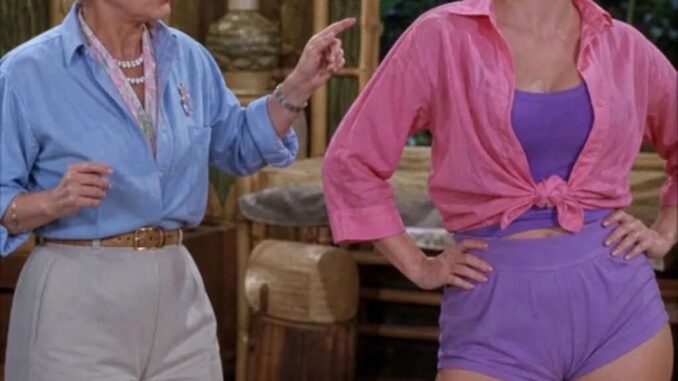
For generations of television viewers, Gilligan’s Island has remained one of the most recognizable sitcoms of its era. Its colorful characters, simple comedy, and seemingly isolated tropical setting created a world that felt surprisingly complete despite being produced long before digital effects could hide every production detail.
That is also part of what makes the series so entertaining to revisit today.
Modern viewers watching episodes in higher quality, pausing scenes, or replaying favorite moments can sometimes spot small production details that audiences watching television in the 1960s were never expected to notice.
These Gilligan’s Island mistakes range from changing props and costumes to visible studio elements, inconsistent scenery, and objects that appear to move between shots.
Rather than ruining the show, many fans now consider these imperfections part of its charm.
They offer a glimpse behind the scenes of classic television and show how producers, actors, designers, camera crews, and editors created an imaginary island using the practical tools available at the time.
Gilligan’s Island Was Built Without Modern Digital Effects
Today, television productions can digitally remove equipment, alter backgrounds, correct unwanted reflections, or replace entire environments during post-production.
Gilligan’s Island belonged to a very different television era.
The tropical world surrounding the cast had to be created with physical sets, practical props, painted or constructed backgrounds, carefully selected camera angles, and location footage.
Everything that appeared on screen had to exist somewhere in front of the camera.
That meant small production imperfections were sometimes unavoidable.
A portion of a studio structure might become visible at the edge of a shot. A background could look slightly different from one scene to another. Vegetation, rocks, or structures could appear in places where viewers did not remember seeing them previously.
At normal television speed, most audiences probably never noticed.
Decades later, however, these details have become part of the fun of rewatching the show.
The SS Minnow Did Not Always Look Exactly the Same
One of the most familiar elements associated with Gilligan’s Island is, of course, the SS Minnow.
The famous boat was central to the series’ premise. It was the vessel that carried the passengers on what was supposed to be a short sightseeing trip before a storm left them stranded.
But creating the illusion of one consistent boat and one isolated island was not always simple.
Different sets, filming environments, props, and exterior footage could be used depending on what a scene required.
Because of that, careful viewers may notice that certain surroundings do not always match perfectly.
The location of objects can change. Background scenery may look slightly different. Parts of the environment can seem larger, smaller, closer, or farther away depending on the scene.
What initially looks like a continuity error becomes much more interesting when viewed as evidence of how television production worked at the time.
The goal was not to create a world that could survive frame-by-frame analysis decades later.
The goal was to create a convincing television comedy that audiences would enjoy once a week.
Costume and Jewelry Changes Are Easier to Spot Today
Not every Gilligan’s Island mistake involved scenery.
Some of the easiest continuity differences to notice involve clothing, accessories, and jewelry.
An item can sometimes appear in one camera angle and disappear in another. Clothing may sit differently between shots, or a small costume detail may change after an edit.
These differences often happen because television scenes are rarely filmed continuously from beginning to end with every camera capturing the action at exactly the same moment.
A scene can be recorded several times.
The camera position changes. Actors repeat movements. Props must be returned to their previous locations. Clothing and accessories have to remain consistent throughout multiple takes.
If even one small detail is overlooked, it may appear as a continuity mistake in the final episode.
Modern viewers are especially good at spotting these moments because streaming and digital video make it possible to pause an episode instantly.
Audiences originally watching Gilligan’s Island on television did not have that luxury.
Props Sometimes Seem to Move on Their Own
Another classic source of television continuity errors is the placement of props.
A cup may face one direction in a wide shot and another direction seconds later.
An object that was sitting near one character can suddenly appear closer to someone else.
Food on a plate may change between camera angles.
A chair, tool, container, or piece of clothing may move slightly even though nobody appears to have touched it.
These small differences often happen because scenes are assembled from multiple takes.
If an actor picks up an object during one version of the scene, the production team must remember exactly where the object was positioned before filming the next take.
On a busy television set with dozens of things happening at once, perfect continuity is difficult.
The mistakes that remain offer viewers a small reminder of the enormous amount of coordination happening just outside the camera frame.
Television Was Produced Much Faster Than Many Viewers Realize
Classic sitcoms were created on demanding schedules.
Crews had episodes to complete, performances to capture, sets to prepare, costumes to manage, scripts to follow, and production deadlines to meet.
A tiny continuity difference that did not affect the joke or the story was rarely worth stopping an entire production.
If the actors delivered a strong performance but a background object had moved slightly, the production team might simply use the best take.
That choice makes sense when television is viewed as a collaborative production rather than a collection of perfectly controlled images.
Performance mattered.
Timing mattered.
Finishing the episode mattered.
Small visual differences were usually far less important.
That is one reason older television programs can feel surprisingly human compared with heavily polished modern productions.
Some Mistakes Only Became Obvious Decades Later
The way people watch television has changed dramatically since Gilligan’s Island first aired.
Older television sets were smaller and displayed significantly less visual detail than modern high-definition screens.
Viewers usually watched an episode when it was broadcast and then waited for another opportunity to see it again.
There was no instant rewind button.
There were no streaming platforms offering every episode on demand.
There were no screenshots circulating online within minutes.
Because of this, production teams could reasonably assume that tiny background details would never receive intense scrutiny.
Today, the situation is completely different.
A viewer can pause a scene, zoom in on an object, compare two shots, and share the discovery with thousands of other fans.
A tiny production detail that once lasted less than a second can become a conversation decades later.
Fans Now Treat the Mistakes Like Hidden Discoveries
For many fans, finding continuity mistakes has become part of the entertainment.
Rewatching a familiar episode is no longer only about remembering the storyline.
Viewers begin watching the background.
They look at costumes.
They notice props.
They compare locations.
They pay attention to objects sitting behind the actors rather than focusing only on the dialogue.
Suddenly, an episode that someone has seen many times can feel new again.
The viewer is not simply following the story anymore.
They are also looking at how the story was constructed.
That creates a different relationship with the series.
Instead of weakening the illusion, these small production mistakes often make audiences appreciate how much effort was required to create it.
The Island Was a Television Illusion—and That Is Part of the Appeal
Gilligan’s Island succeeded because audiences accepted its fictional world.
Viewers knew that the characters were not truly stranded indefinitely on a remote tropical island.
They knew they were watching actors.
Yet the show created a setting familiar enough that people could imagine where each character lived, where conversations happened, and where the castaways would gather when another unusual problem appeared.
The series created that familiarity through repetition.
The huts, beaches, jungle surroundings, costumes, and recurring props gradually became recognizable parts of the show.
Occasionally seeing a detail that exposes the production process does not erase that familiarity.
Instead, it reveals the craftsmanship behind it.
A visible edge of a set or an inconsistent background reminds viewers that the island was built piece by piece by real people.
Continuity Errors Can Reveal How Scenes Were Filmed
A continuity mistake can also provide clues about how a scene was assembled.
Imagine that a character is holding an object in one shot.
The camera cuts to another actor.
When the camera returns, the object is suddenly being held differently.
That may indicate that the two shots were taken during separate performances.
Likewise, changing food, drinks, clothing positions, or background objects can reveal where editors combined different takes.
For viewers interested in television history, these moments are almost like production fingerprints.
They show that what appears to be one uninterrupted conversation may actually have been built from several pieces recorded at different times.
It gives viewers a small glimpse into the editing room without ever leaving the episode.
The Mistakes Do Not Take Away From the Comedy
Most importantly, these imperfections have done very little to weaken the lasting popularity of Gilligan’s Island.
Fans still remember the personalities of the castaways, the absurd situations they encountered, and the recurring attempts to escape the island.
The comedy remains the reason people return.
A misplaced prop does not change a joke.
A slightly different background does not erase a character.
A costume continuity error does not change the affection viewers have developed for the series.
If anything, these small imperfections can make the show feel warmer.
They remind us that classic television was created by people solving practical problems rather than computers correcting every frame.
Gilligan’s Island Is Also a Time Capsule
Looking closely at the program reveals more than television mistakes.
It also reveals the style and expectations of its era.
Clothing, hairstyles, dialogue, set decoration, social customs, technology, and even ordinary household objects preserve details of mid-20th-century American popular culture.
Some things now look immediately old-fashioned.
Others feel surprisingly familiar.
That contrast helps explain why programs like Gilligan’s Island continue to attract viewers who were not even alive when the show originally aired.
The series is entertainment, but it is also an accidental historical record.
It preserves what television producers believed audiences would recognize and understand at the time.
Modern Viewers See the Show Differently
Every generation brings different knowledge to older entertainment.
A viewer watching decades ago may have focused almost entirely on the characters and comedy.
Someone watching today might notice the camera work, production design, costume choices, or practical effects.
Another viewer may recognize details about television production that they learned from documentaries or behind-the-scenes material.
That means the same scene can reveal something different depending on who watches it.
Personal memory also plays a role.
Someone who watched Gilligan’s Island as a child may remember the island as enormous and completely convincing.
Returning to those same episodes on a modern screen can reveal how compact some sets actually were.
That difference between memory and reality can make rewatching the series especially interesting.
Context Matters When Examining Old Television
It is easy to judge older television using modern production standards.
However, doing so can overlook the conditions under which those programs were created.
Technology was different.
Television resolution was different.
Production schedules were different.
Audience viewing habits were different.
What looks like an obvious mistake on a large modern display might have been virtually invisible to the average viewer watching the original broadcast.
That context matters.
The most interesting question is often not simply, “How did they miss this?”
A better question is, “Why would this detail have mattered so little when the episode was originally produced?”
The answer often reveals more about television history than the mistake itself.
Why Gilligan’s Island Mistakes Remain So Entertaining
There is something enjoyable about discovering an imperfection inside something familiar.
Fans already know the characters.
They know the setting.
They often know how the episode ends.
Finding a small continuity error creates a new reason to pay attention.
It turns passive nostalgia into active observation.
A viewer who has seen the same episode repeatedly may suddenly notice a background object they never saw before.
That discovery can make an old scene feel fresh again.
It is one reason classic television continues to generate conversation long after the original broadcasts disappeared from weekly schedules.
Small Imperfections Can Make Classic Television Feel More Human
Modern entertainment can sometimes appear almost impossibly polished.
Digital tools can correct backgrounds, remove unwanted objects, change lighting, and even alter performances after filming.
Classic television did not have the same safety net.
The results were sometimes imperfect.
But those imperfections reveal the work.
They remind viewers that actors stood on physical sets, crews moved equipment between scenes, designers constructed environments, and editors manually assembled performances into finished episodes.
Gilligan’s Island was not created by pressing a button and generating a tropical world.
People built that world.
And occasionally, viewers can still see the evidence.
A Different Kind of Nostalgia
Rewatching Gilligan’s Island is therefore about more than remembering old jokes.
It offers a chance to examine how entertainment was produced during another era.
The mistakes, changing props, practical sets, costume differences, and inconsistent background details all belong to that history.
They do not need to be treated as failures.
Instead, they can be viewed as small windows into the production itself.
The fictional island may have been imperfect, but it was memorable enough that audiences are still examining it decades later.
And perhaps that is why the Gilligan’s Island mistakes have become part of the show’s lasting charm.
They remind us that behind the tropical scenery, familiar characters, and television comedy was a group of real people creating an imaginary world under real production limits.
The island was never perfect.
It never needed to be.
Sometimes the details that were never meant to be noticed are exactly the ones that make an old television show worth watching again.
Leave a Reply