

Some photographs do more than capture a person. They seem to open a door to another time.
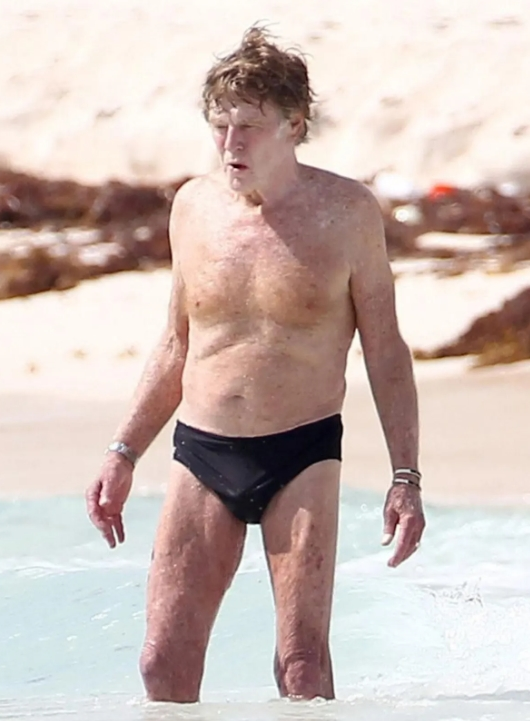
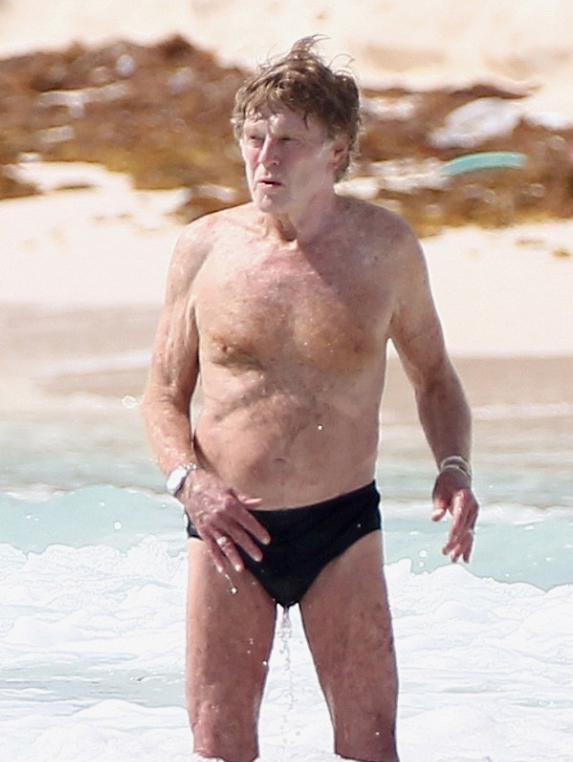
In these candid beachside images, an older gentleman walks through the shallow water with the relaxed manner of someone far removed from movie premieres, bright studio lights, and red-carpet applause. His hair is tousled by the coastal breeze. His expression is thoughtful, almost private.
Yet there is something unmistakably familiar about him.
For Americans who grew up watching movies in neighborhood theaters, drive-ins, and wood-paneled living rooms, that face carries decades of memories. It recalls sweeping romances, political mysteries, Western adventures, and one of the most beloved screen partnerships in Hollywood history.
The man in the photograph was Robert Redford, the actor, director, producer, environmental advocate, and founder of the Sundance Institute.
He died peacefully in his sleep at his Utah home on September 16, 2025. He was 89 years old. His passing marked the end of an extraordinary chapter in American film, but the stories he helped create remain as vivid as ever.
When Movie Stars Still Seemed Larger Than Life
For many older moviegoers, Robert Redford belonged to an era when Hollywood stars possessed a certain mystery.
Audiences did not follow every hour of an actor’s life through social media. They encountered their favorite performers in theaters, magazine profiles, late-night interviews, and the occasional television appearance. Between films, the stars seemed to disappear into lives the public could only imagine.
Redford fit that world perfectly.
He had the effortless appearance of a classic leading man, but his performances often revealed something more complicated beneath the surface. His characters could be charming without being simple, confident without being invulnerable, and heroic without pretending to have all the answers.
Born Charles Robert Redford Jr. in Santa Monica, California, in 1936, he initially explored art and athletics before studying acting. His early career included theater and television appearances, including roles on programs such as The Twilight Zone and Alfred Hitchcock Presents. Broadway helped sharpen his craft before the movies made him famous.
Video : From the archives: Three interviews with Robert Redford
The Films That Became American Memories
Redford’s rise arrived during a remarkable period of change in American cinema.
In 1969, he appeared opposite Paul Newman in Butch Cassidy and the Sundance Kid. Their chemistry felt natural, playful, and entirely unforced. The movie transformed both men into one of cinema’s most memorable screen partnerships.
They reunited for The Sting in 1973, delivering another stylish crowd-pleaser filled with humor, friendship, and old-fashioned movie-star charm.
For viewers who saw those films during their original theatrical runs, the memories may be inseparable from the experience itself: standing beneath a glowing marquee, buying a paper ticket, hearing the curtains open, and watching two charismatic actors command the screen.
But Redford never remained in one comfortable category.
He shared a bittersweet romance with Barbra Streisand in The Way We Were. He entered the tense world of investigative journalism in All the President’s Men. He brought quiet dignity to Jeremiah Johnson, nostalgic wonder to The Natural, and mature romanticism to Out of Africa.
Each role revealed another side of an actor who understood the power of restraint.
A Familiar Face Away From the Cameras
Candid photographs can be surprisingly emotional because they remove the distance created by fame.
There is no carefully arranged movie lighting in these beach images. No costume department has selected the clothes. No director is waiting behind the camera to call “action.”
There is simply an older man standing near the water.
Aging is often treated harshly in popular culture, especially when famous faces are involved. Yet photographs such as these can offer a more meaningful perspective. They remind us that growing older is not a disappearance. It is evidence of a life that has continued through changing decades, private joys, professional triumphs, and painful losses.
Redford’s later appearance did not erase the young outlaw, determined journalist, gifted ballplayer, or romantic leading man audiences remembered. All those characters remained part of the same life.
Video : Robert Redford on his friendship with Paul Newman
The Director Behind the Famous Face
Although Redford could easily have spent his career relying on his movie-star appeal, he chose a more challenging path.
His directing debut, Ordinary People, told an intimate story about grief, family tension, and the difficulty of emotional honesty. Released in 1980, the film won the Academy Award for Best Picture, while Redford received the Oscar for Best Director.
It was an impressive achievement for a first-time feature director and demonstrated that his instincts extended far beyond acting.
He later directed films including A River Runs Through It and Quiz Show, continuing his interest in moral choices, complicated families, and the hidden pressures beneath respectable American life.
His direction was rarely flashy. Like his best acting, it trusted audiences to notice quiet expressions, unfinished conversations, and the meaning contained in silence.
Creating a Home for Independent Storytellers
Redford’s influence reached well beyond the films carrying his name.
In 1981, he founded the Sundance Institute to support independent artists, original storytelling, and filmmakers whose voices might otherwise have struggled to reach an audience. The organization began by bringing emerging filmmakers to Utah for creative development and mentorship.
Over time, Sundance became one of the most important institutions in independent cinema, helping generations of filmmakers develop unconventional and deeply personal work.
This may ultimately be one of Redford’s greatest contributions.
He did not merely protect his own place in Hollywood. He used his success to create opportunities for people who had not yet been invited inside.
The 2026 Sundance Film Festival honored its late founder and reflected on the creative home he had built for independent artists. The tribute demonstrated how far his original vision had traveled—and how many careers it had helped begin.
A Life Guided by More Than Fame
Redford also became closely associated with environmental conservation and the landscapes of the American West.
Utah was more than a picturesque retreat for him. It represented privacy, independence, and a connection to the natural world. His advocacy reflected a belief that progress should not require sacrificing the land inherited by future generations.
In 2016, President Barack Obama presented Redford with the Presidential Medal of Freedom, the nation’s highest civilian honor. The recognition celebrated not only his accomplishments in entertainment but also his cultural and civic influence.
The honor felt appropriate for someone whose career had gradually expanded from movie stardom into directing, artistic mentorship, and public advocacy.
Why His Work Still Feels Personal
Certain performers become connected to the seasons of our lives.
A couple may remember watching The Way We Were during their early courtship. A father and son may share a love of The Natural. Someone who once dreamed of journalism may still feel inspired by All the President’s Men. Another viewer may hear the opening notes of a familiar film score and suddenly remember a theater that closed decades ago.
That is the quiet power of a lasting screen legacy.
Redford’s films survive not simply because critics praised them or because they received awards. They survive because people attached their own memories to them.
The Photograph Becomes a Farewell
Knowing that Robert Redford is gone changes the way these candid photographs feel.
What might once have seemed like an ordinary celebrity sighting now appears more reflective. The ocean, the sunlight, and the solitary figure create an unplanned farewell to a man who spent much of his life balancing public admiration with a desire for independence.
He was one of Hollywood’s most recognizable leading men, yet he became something even more enduring: a filmmaker who valued substance, an advocate who defended the natural world, and a mentor who opened doors for storytellers who followed him.
The young movie star belonged to another era.
The work, however, still belongs to everyone.
Leave a Reply