
I had always been proud of the kind, compassionate young man my son was becoming.
For seventeen years, I watched Aaron grow from a curious little boy who cried when he accidentally stepped on an ant into a teenager who would stop whatever he was doing to help someone else. He was the kind of person who noticed things most people ignored.
He noticed when someone at school was sitting alone.
He noticed when a neighbor struggled to carry groceries.
He noticed when a friend’s smile looked a little less genuine than usual.
And every single time, he did something about it.
I thought I understood my son. I thought I knew exactly who he was.
Then one phone call from my best friend made me question everything—not because Aaron had done something wrong, but because I realized he had become someone far greater than I ever imagined.
The morning everything began seemed completely ordinary.
It was one of those quiet September mornings I had learned to appreciate more as I got older. The sunlight poured through the kitchen windows, spreading across the countertops in warm golden patches. The house was peaceful except for the sound of cabinets opening and closing.
I stood at the kitchen sink, washing a coffee mug, while listening to my son search through the pantry for what seemed like the hundredth time.
“Mom, did you hide the granola bars again?”
Aaron’s voice came from behind a wall of cereal boxes.
I smiled despite myself.
At thirty-nine years old, I had learned something important: peace was usually quiet. It wasn’t always found in big moments or exciting events. Sometimes peace was simply standing in your kitchen on a normal morning, listening to your teenage son complain about missing snacks.
“They’re on the second shelf, where they always are,” I called back. “Who eats four granola bars before noon?”
A few seconds later, Aaron appeared holding a plastic bag.
“They’re for Lily,” he said.
The way he said it was so casual, like he was talking about picking up coffee for a friend.
“Lily likes the chocolate ones,” he added. “The hospital food is awful.”
I dried my hands with a towel and watched him carefully pack the bag.
There was something about the way Aaron did things. He never rushed when someone else needed him. He packed those snacks with the same concentration he used to have when he was younger, carefully organizing his Lego sets by color and size.
That was always Aaron.
Thoughtful.
Patient.
Kind.
He was a good student, never caused trouble, and had the kind of heart that made teachers tell me, “You should be proud of him.”
And I was.
More than he knew.
When Aaron started dating Lily about a year earlier, I remember calling Diane almost immediately.
Diane had been one of my closest friends for more than a decade. Our families had spent countless holidays together, shared backyard dinners, and watched our children grow up side by side.
Lily and Aaron had practically known each other their entire lives.
The first time they held hands at a backyard barbecue, Diane and I had pretended not to notice. We tried to act like normal adults, but the moment we got inside the kitchen, we completely lost our composure.
We laughed.
We smiled.
We talked about them for almost an hour like two teenagers ourselves.
“They’re adorable,” Diane had said.
“They really are,” I agreed.
We were both so happy because it was obvious they cared about each other. Aaron looked at Lily differently than he looked at anyone else. He listened when she spoke. He remembered tiny details about things she liked. He made her laugh when she was stressed.
They were young, but their relationship felt genuine.
Then everything changed.
Four months before that September morning, Lily was diagnosed with cancer.
One day, Aaron and Lily were arguing about prom themes, talking about college plans, and making weekend plans.
The next day, they were sitting in hospital rooms.
Instead of discussing what they would wear to dances, they were discussing treatment schedules.
Instead of worrying about exams, they were worrying about test results.
Instead of making memories the way teenagers were supposed to, they were forced to deal with something no seventeen-year-old should have to face.
The diagnosis devastated everyone.
But I think it hurt Aaron in a way he never fully admitted.
He loved Lily deeply, and watching someone you love suffer while knowing you cannot fix it is one of the hardest feelings in the world.
Still, he never walked away.
Not once.
Aaron visited her whenever he could.
He brought her favorite snacks.
He helped her keep up with schoolwork when she was too exhausted to focus.
He watched terrible movies with her because she loved them.
He sat beside her hospital bed for hours, sometimes saying nothing at all, just making sure she wasn’t alone.
One afternoon, I found him asleep in the living room chair after coming home from the hospital. His backpack was still on his shoulder, and his homework was open on the table.
He was exhausted.
But the next morning, he still got up and went back.
“You’re going again today?” I asked him one afternoon, even though I already knew the answer.
He zipped up the bag of snacks and nodded.
“She’s having a rough week,” he said quietly. “I told her I’d be there by four.”
I watched him for a moment.
“You know you don’t always have to be strong for everyone, right?”
He shrugged.
“I know.”
But the truth was, Aaron had always been that way.
He carried other people’s pain as if it belonged to him.
I reached for my coffee and tried to smile.
“Tell Diane I said hi. I texted her yesterday, but she barely responded.”
Aaron stopped for just a second.
It was small.
Almost unnoticeable.
But I saw it.
“She’s tired, Mom,” he said.
“I know.”
And I did know.
Diane was Lily’s mother. She was living every parent’s worst nightmare. Her entire world had become hospital rooms, medication schedules, and waiting for doctors to deliver news.
I understood why she was overwhelmed.
But I had noticed the change.
For weeks, Diane’s messages had become shorter.
A long conversation turned into a simple thumbs-up.
A phone call turned into a one-word reply.
A paragraph became “k.”
I told myself it was the stress.
The chemotherapy.
The lack of sleep.
The fear.
After all, someone fighting to keep their child alive doesn’t owe anyone casual conversation.
Aaron walked over and kissed the top of my head.
That gesture still made me smile because, despite everything, he was still my little boy in so many ways.
“Drive carefully,” I said.
“Always.”
I watched him grab his keys and walk outside.
Through the kitchen window, I saw him climb into his old Civic and drive away.
The house became quiet again.
But this time, the silence felt different.
I couldn’t explain it.
I just had the strange feeling that something was changing.
I didn’t know then that my son was about to do something that would affect an entire hospital floor.
And I had no idea that the next day, I would receive a phone call from Diane that would leave me terrified.
Because when she called, she didn’t sound like my best friend.
She sounded like someone who had just witnessed something she didn’t know how to understand.

The changes in Lily became harder to ignore as the weeks passed.
Cancer had already taken so much from her.
At seventeen years old, she should have been worrying about homework, college applications, friendships, and what dress she wanted to wear to prom.
Instead, she was spending her days in hospital rooms, surrounded by machines, medication, and adults speaking in careful voices.
The treatments started taking a visible toll.
Her energy disappeared first.
Then came the days when she was too tired to even sit up for long conversations.
But the hardest thing for her was losing her hair.
I remember the first time I saw her after her hair started falling out.
She tried to make a joke about it.
“Lucky for me, I never really liked styling it anyway,” she said with a small smile.
But I saw the sadness behind her eyes.
Everyone did.
No matter how brave someone tries to be, losing a part of yourself unexpectedly changes the way you see yourself.
And for a teenage girl who was already fighting for her life, losing her hair felt like another reminder that cancer was taking control.
Diane struggled with it too.
I could see how much pain she carried every day.
She was trying to be strong for Lily, but there were moments when the exhaustion showed.
The woman who once laughed loudly at family dinners now looked like she was carrying the weight of the entire world.
Then one evening, something happened that I would never forget.
I was sitting in the living room folding laundry when I heard Aaron coming down the stairs.
Usually, I could tell what kind of mood he was in just by his footsteps.
When he was happy, he moved quickly.
When he was tired, he dragged his feet.
But this time was different.
The footsteps were slow.
Careful.
Almost hesitant.
I looked up.
The laundry basket slipped from my hands.
Because standing at the bottom of the stairs was my son.
But he looked completely different.
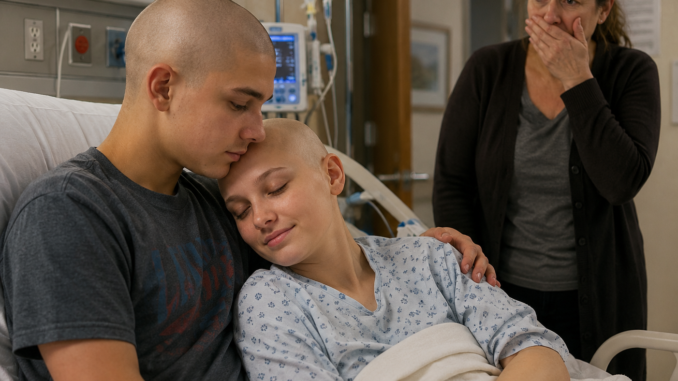
His hair was gone.
Not shorter.
Not trimmed.
Gone.
His head was completely shaved, leaving his scalp exposed under the warm living room light.
For a moment, I couldn’t even speak.
“Aaron…”
My voice came out as a whisper.
“What did you do?”
He touched the top of his head, almost embarrassed.
A small smile crossed his face.
“I knew you’d freak out a little.”
“A little?” I walked toward him, still trying to process what I was seeing. “Honey, your hair. Why?”
Without thinking, I reached up and touched his head.
The feeling was strange.
The curls I had run my fingers through when he was a little boy were gone.
Instead, my hand touched smooth skin.
Aaron didn’t pull away.
He just stood there and looked at me with those calm brown eyes that had always seemed much older than his seventeen years.
“Mom,” he said softly, “Lily is losing hers in clumps now.”
My expression changed immediately.
He looked down.
“She tried to laugh about it last week. She told me she didn’t care.”
His voice became quieter.
“But I found her crying in the bathroom when she thought I had gone to get coffee.”
My heart tightened.
I knew exactly what he meant.
Because Lily wasn’t just losing hair.
She was losing pieces of the life she knew.
Aaron took a deep breath.
“I hated seeing her feel like that.”
He ran his hand over his shaved head.
“I wanted her to know something.”
“What?”
“That she’s still beautiful.”
His words were simple, but the emotion behind them almost broke me.
“I wanted her to know that beauty isn’t in her hair. It isn’t in whether she looks the way she did before.”
He swallowed.
“And she doesn’t have to go through this alone.”
I stood there silently.
Then he said the words that stayed with me forever.
“If she’s gonna look like this, then I will too.”
For a moment, I couldn’t say anything.
I just looked at my son.
My teenage boy.
The child I had raised.
The boy who used to ask me to check under his bed for monsters.
The boy who once cried because his friend lost a pet.
And somehow, somewhere along the way, he had become someone who understood love in a way many adults never do.
“You’re a good kid, Aaron,” I finally whispered.
My voice cracked.
“You’re a really, really good kid.”
He immediately looked uncomfortable.
That was Aaron.
He never wanted attention for doing something kind.
He shrugged.
“Mom, it’s not a big deal.”
But it was.
It was one of the biggest things I had ever seen.
“I’m gonna go to bed,” he said. “I have a long day tomorrow.”
I smiled slightly.
“Are you seeing her after school?”
He grabbed his backpack and nodded.
“Yeah. Coach gave me the afternoon off from practice.”
I watched him walk upstairs.
And then I just stood there.
In the middle of the living room.
With a pile of laundry scattered around me.
I felt something I could barely describe.
Pride.
Not the kind parents feel when their child gets good grades or wins an award.
Something deeper.
Something bigger.
I was proud of the person he had become.
I thought that moment would be the end of the story.
I thought it would simply be one of those memories I would tell people years later.
The story of how my son shaved his head for the girl he loved.
I had no idea that the next day, everything would become much more complicated.
The following afternoon, I was sitting in the living room working on an email I had been avoiding when my phone buzzed on the kitchen counter.
I glanced over.
Diane’s name appeared on the screen.
Immediately, I smiled.
I assumed she had seen Aaron.
I assumed she was calling to tell me how touched she was.
Maybe Lily had laughed when she saw him.
Maybe the two of them had shared one of those rare moments where cancer disappeared for just a little while.
I picked up the phone.
“Hey, you,” I said warmly.
Then I continued without waiting.
“Did he get there yet? I should’ve warned you. I almost dropped a basket of clothes when I saw him. How is Lily?”
But before I could finish, Diane interrupted.
“Rachel.”
Something about her voice stopped me.
It wasn’t the Diane I knew.
It wasn’t warm.
It wasn’t tired.
It was tense.
Almost broken.
My smile disappeared.
“Di?”
I sat up straighter.
“Is everything okay?”
A few seconds passed.
Then she said quietly:
“Lily’s fine.”
I let out a breath.
But then I heard something in her voice.
A tremble.
A hesitation.
“Rachel, you need to come down here to the hospital and see for yourself what your son did.”
My stomach dropped.
“What?”
“I don’t know how to feel about it.”
Her voice became softer.
“Please just come.”
The room suddenly felt colder.
I gripped the edge of the counter.
“Diane, what do you mean? Did something happen? What did Aaron do?”
“Just come.”
“No, Diane, talk to me.”
“I can’t do this on the phone.”
Then the line went silent.
I stood there frozen.
The phone was still pressed against my ear, but Diane was already gone.
And suddenly, my mind filled with every possible terrifying thought.
Had Lily gotten worse?
Had something happened during treatment?
Had Aaron said something wrong?
Had he crossed some line I didn’t know about?
I grabbed my keys.
I didn’t even stop to put on a jacket.
The entire drive to the hospital, my hands shook against the steering wheel.
Every red light felt too long.
Every second felt heavier.
Because one sentence kept repeating in my mind.
“What did my son do?”
When I finally reached the hospital, I barely remembered parking.
The automatic doors opened, and I rushed inside with my keys still clenched in my hand.
And standing in the hallway waiting for me was Diane.
Her arms were crossed tightly over her chest.
Her face looked exhausted.
Her eyes were red.
She didn’t smile.
She didn’t say hello.
She only looked at me and said:
“Rachel. Come with me.”
And as I followed my best friend down the hospital corridor, I had no idea that the truth waiting behind that hospital room door would change the way all of us understood love.

I followed Diane through the hospital hallway, trying desperately to understand what was happening.
The familiar sounds of the hospital surrounded us.
The quiet beeping of machines.
The soft footsteps of nurses moving between rooms.
The distant voices of doctors discussing patients.
Normally, hospitals made me feel like I was surrounded by people trying to help.
But that day, walking behind Diane, every sound felt heavier.
“Diane, please,” I said again. “Just tell me what happened.”
She kept walking.
Her eyes stayed fixed ahead.
Finally, she spoke.
“He crossed a line.”
I stopped for half a second.
“A line?”
My voice rose slightly.
“Diane, my son shaved his head for your daughter. He did it because he loves her.”
She stopped so suddenly that I almost walked into her.
Then she turned around.
Her eyes were filled with tears, but her expression was firm.
“It isn’t just the shaving thing, Rachel.”
Her voice dropped.
“It’s what he did next.”
I stared at her.
“What are you talking about?”
Diane looked away.
And in that moment, I saw something I had never seen from her before.
Conflict.
Pain.
Guilt.
“Aaron has barely slept in months,” I said, defending him before she even finished. “He comes here after school. He brings Lily soup. He sits in waiting rooms doing homework on his lap. He stays until she falls asleep.”
“I know.”
Her answer came quickly.
Too quickly.
“Then why are you acting like he did something wrong?”
Diane closed her eyes for a moment.
“Lily is a private girl, Rachel.”
I waited.
“Now the entire oncology floor is talking.”
Her voice cracked.
“Everyone has an opinion. Everyone has a story about my daughter.”
I felt my own frustration rising.
“You called me like something terrible happened. I drove here thinking Lily was—”
I stopped myself.
I couldn’t even finish the thought.
Diane looked down.
“I know.”
“Then help me understand.”
She looked at me, and for the first time since I arrived, the anger in her face faded.
“You don’t understand.”
“Then explain.”
She took a shaky breath.
“For weeks, Rachel. For weeks, I’ve watched him walk into this hospital and make her laugh.”
Her voice became quieter.
“He makes her eat. He makes her sit up. He makes her forget for a few minutes that she’s sick.”
I didn’t say anything.
Because I knew exactly what she meant.
“But I stand at the foot of her bed,” Diane continued, “and I can’t even get her to drink water.”
My heart softened.
“Diane…”
“Aaron comes in with snacks, and my daughter lights up.”
She wiped her eyes.
“I bring her favorite blanket from when she was six years old, and she just turns away.”
I took a step closer.
“That isn’t his fault.”
“I know.”
Her voice broke.
“I know it’s not his fault.”
She looked angry at herself.
“But knowing something doesn’t mean it doesn’t hurt.”
For a moment, neither of us spoke.
The hallway continued moving around us.
A nurse pushed a cart past.
A doctor walked by holding a clipboard.
The world continued as if ours had not just cracked open.
Then Diane whispered something that surprised me.
“I’ve been jealous of a seventeen-year-old boy.”
I stared at her.
“What?”
“I’ve been jealous of him because he can do something I can’t.”
She looked toward Lily’s room.
“He can make her smile.”
Her eyes filled again.
“And I’m her mother. I’m supposed to be the person who makes everything better.”
“Diane…”
“I hate that I feel this way.”
She shook her head.
“I hate that I’m angry at someone who is helping my daughter.”
I reached for her arm.
“This isn’t who you are.”
She looked at me sadly.
“Maybe it is who I’ve been.”
Her voice was barely above a whisper.
“And I hate it.”
We finally reached Room 412.
Diane stopped outside the door.
Her hand rested on the handle.
I could hear something coming from inside.
At first, I thought I was imagining it.
Then I heard it again.
Laughter.
Real laughter.
Not the polite kind people give when they are trying to pretend everything is okay.
This was loud.
Unexpected.
The kind of laughter that comes from forgetting, even for a moment, that life is difficult.
Lily was laughing.
I hadn’t heard that sound in months.
Diane looked at me.
Tears filled her eyes.
“I tried to convince myself that he was turning her into a spectacle,” she whispered.
I looked at the door.
“But listen to her.”
I swallowed.
“He’s giving her back to herself.”
Diane closed her eyes.
“I can hear it now.”
Then she opened the door.
And everything stopped.
I stepped inside.
And froze.
Aaron was sitting beside Lily’s hospital bed.
Both of them were laughing so hard that Lily had one hand over her stomach.
Her face was brighter than I had seen it in months.
And behind Aaron, standing in the hallway, was something I never expected.
A whole group of people.
A dozen boys with freshly shaved heads.
I blinked.
I couldn’t understand what I was seeing.
Then I recognized them.
The soccer team.
Aaron’s teammates.
Two of his teachers.
And even the young hospital chaplain.
Every one of them had shaved their heads.
Every one of them was smiling.
Nurse Maria, who had been standing nearby, immediately waved me over.
“Come see this,” she said.
She was holding her phone.
“I recorded everything.”
I looked at Aaron.
He looked embarrassed.
Like he still couldn’t understand why everyone was making such a big deal.
Maria pressed play.
The video started with one person walking into the room.
Aaron’s soccer coach.
Coach Daniels.
He stepped inside dramatically, bowed, and rubbed his newly shaved head.
Lily covered her mouth in surprise.
Then she laughed.
A real laugh.
One by one, people entered.
Each person had the same message.
“You are not alone.”
“We’re with you.”
“You don’t have to fight this by yourself.”
Lily’s eyes filled with tears.
Not sad tears.
The kind that come when someone reminds you how loved you are.
I looked at Aaron.
“You did all this?”
He shrugged.
“I’ve been asking around for a couple of weeks.”
He glanced at Lily.
“Everyone wanted to help.”
“Why didn’t you tell me?”
He smiled slightly.
“Because then you would’ve tried to help organize it.”
I laughed through my tears.
That sounded exactly like something he would say.
I turned back toward Diane.
She wasn’t angry anymore.
She wasn’t confused.
She was simply crying.
Her arms hung at her sides.
“I couldn’t say it on the phone,” she whispered.
I walked closer.
“What?”
She looked at me.
“I kept trying to say, ‘Look what your son did.’”
Her voice broke.
“But every time I started, I realized it wasn’t something bad.”
She wiped her cheeks.
“It was something beautiful.”
I pulled her into a hug right there in the doorway.
She cried against my shoulder.
“I’ve been so jealous of him, Rachel.”
I held her tighter.
“I know.”
“No, I mean really jealous.”
She took a shaky breath.
“I watched him walk in here and bring my daughter back to life for a few minutes, and I hated that I couldn’t do the same thing.”
I pulled back and looked at her.
“Diane, we’re not rivals.”
She looked at me.
“We’re mothers.”
I squeezed her hand.
“We’re on the same side.”
For a moment, she just stared at me.
Then she nodded.
“We’re in this together.”
Six weeks later, we received news we had all been praying for.
Lily’s scans came back.
The treatment was working.
It wasn’t the end of the journey.
There were still challenges ahead.
Still appointments.
Still difficult days.
But for the first time in a long time, there was hope.
Diane and I sat together on my porch that evening, drinking tea and watching the sun disappear behind the trees.
For the first time in months, neither of us felt like we were waiting for bad news.
Aaron sat nearby, laughing with Lily over something on his phone.
His hair had started growing back.
Soft, dark patches covered his head.
Lily’s hair was slowly returning too.
Diane watched them quietly.
“You know,” she said, “I thought I was losing my daughter.”
I looked at her.
She smiled sadly.
“But that boy reminded me she was still here.”
I looked over at Aaron.
For years, I thought I was raising a good boy.
I thought kindness meant holding doors open, helping neighbors, and being polite.
I was wrong.
That day in the hospital, I learned that kindness could be much bigger.
It could mean standing beside someone when they felt alone.
It could mean giving up something you loved so another person didn’t feel different.
It could mean bringing an entire room of people together just to remind one scared teenage girl that she mattered.
My son didn’t just shave his head for Lily.
He showed all of us what love was supposed to look like.
And somehow, without even realizing it, my seventeen-year-old son had quietly grown into a man.
Leave a Reply