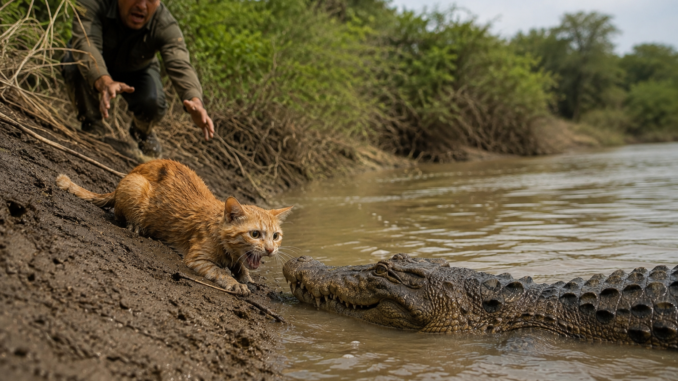
The terrified cat couldn’t move.
Pressed against the muddy riverbank, it cried desperately as a large crocodile slowly crept closer through the shallow water.
With nowhere to run and every escape route blocked, the frightened cat seemed to have run out of time.
Then, one man saw what was happening.
While walking near the river, he heard desperate meows echoing through the quiet surroundings.
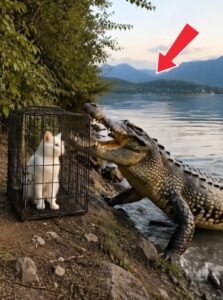
At first, he thought the sound came from bushes along the bank, but after moving closer, he froze at the sight before him.
A frightened cat was trapped near the water’s edge.
The small animal had become caught beneath tangled branches and thick reeds, leaving it unable to climb away. Only a short distance away, a crocodile rested in the water, slowly moving closer toward the shoreline.
The man immediately understood the danger.
Rushing straight toward the cat could have startled both animals. Instead, he quickly looked around and found a long wooden stick lying nearby that could help him keep a safe distance.
He remained calm.
Standing well away from the crocodile, the man used the stick to create noise by striking the ground and nearby vegetation. The sudden disturbance encouraged the crocodile to pause and slowly turn back toward deeper water instead of continuing toward the trapped cat.
The opportunity lasted only a few moments.
As soon as the crocodile moved farther away, the man carefully approached the trapped cat. The frightened animal was shaking, its paws tangled tightly in thick branches and vines.
The rescue required patience.
Pulling the cat too quickly could have caused injury. Instead, the man carefully loosened the branches one at a time while speaking softly to keep the frightened animal as calm as possible.
Helping animals safely often means making careful decisions.
Every year, both pets and wildlife become trapped in natural obstacles, discarded materials, and dangerous environments.
Learning wildlife rescue safety tips helps people understand how to respond responsibly while protecting themselves and the animal.
The cat slowly stopped struggling.
As the branches loosened, the little animal became calmer, almost as if it realised help had finally arrived.
The man continued working carefully until enough space had been created.
Then, the final branch came free.
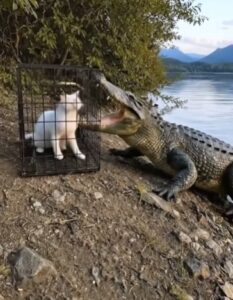
The frightened cat cautiously stepped out of the tangled vegetation. For a few seconds, it remained perfectly still, looking around as though it could hardly believe it was no longer trapped.
The danger had passed.
The man gently encouraged the cat to move farther away from the riverbank before stepping back himself. Keeping a safe distance from the water remained important, as crocodiles can return unexpectedly.
The cat quickly reached safer ground.
After pausing briefly, it disappeared into nearby bushes, free once again after its frightening experience.
The man quietly collected the loose branches left behind.
Removing some of the tangled debris helped reduce the chance of another small animal becoming trapped in the same place.
The experience became a powerful reminder.
Natural habitats can present unexpected dangers for both domestic animals and wildlife. Staying alert and responding calmly can sometimes make the difference between danger and safety.
Understanding how to help injured wild animals is valuable because not every rescue should be attempted alone.
Situations involving large predators or dangerous wildlife often require trained professionals with the proper equipment and experience.
https://twitter.com/i/status/2082494958917881856
Leave a Reply