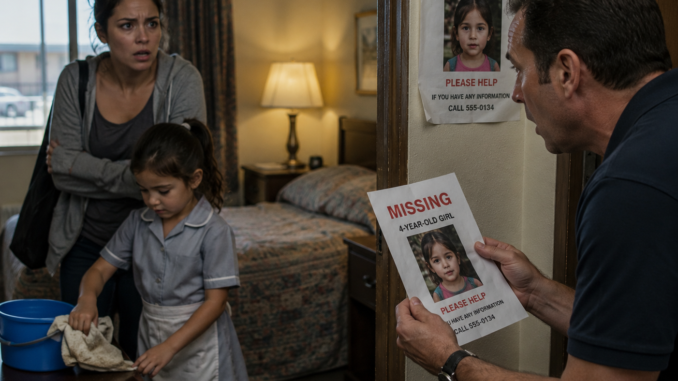
I opened my motel room and found a four-year-old girl on her knees scrubbing the floor.
Her eyes were swollen from crying.
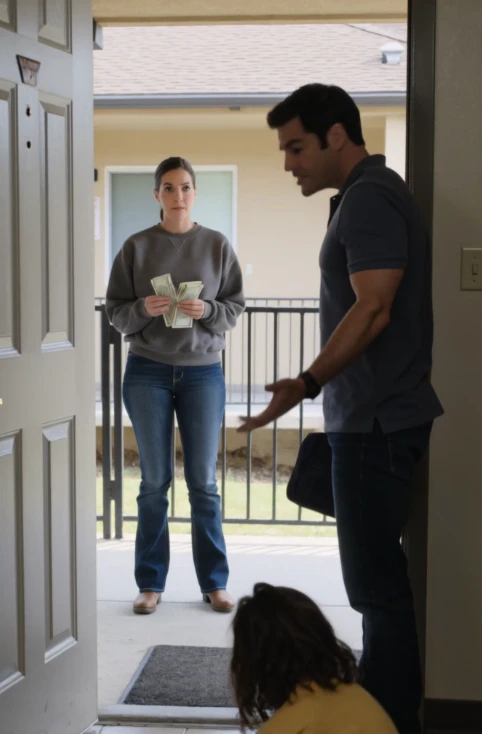
A woman stood in the hallway counting tips.
I asked:
“Why is a child cleaning your rooms?”
The woman snapped:
“She’s my daughter. Mind your business.”
Then the little girl found a cracker under the bed and tried to hide it in her pocket.
The woman ripped it from her hand.
“You eat after you finish working.”
That was when the motel manager walked over.
He looked at the child—
and froze.
“Wait. I know that face.”
The woman immediately grabbed the girl’s hand.
“She’s my daughter. We’re leaving.”
But the manager stepped in front of the door.
Then he said the words that made her stop:
“Her picture is on the missing-person flyer in my office.”
The woman went silent.
I thought we were about to prove she was simply a cruel mother.
I had no idea the real question was whether she was the girl’s mother at all.
And when the child was finally asked what the woman’s name was—
her answer made everyone in that hallway look at each other.
Read to the end. The woman called her “my daughter,” but the missing-person report told a very different story.
My name is Rebecca Lane.
I had checked into the Pine Crest Motor Inn because my car overheated twenty miles outside town.
It was supposed to be one night.
Room 214.
A shower.
Six hours of sleep.
Then back on the road before sunrise.
Instead, at 5:42 that afternoon, I opened my door and found a little girl who would change the way I looked at strangers forever.
She was kneeling beside the bed with a rag in one hand and a bottle of cleaner beside her.
Her knees were red.
Her shoes were too large.
One shoelace had been tied around her ankle to stop it from slipping off.
Her hair had been pulled into a ponytail so tightly that strands had come loose around her face.
And when I asked why she was working, she didn’t look at me.
She looked at the woman in the hallway.
That was the first thing I should have understood.
Children usually look toward a parent for reassurance.
This girl looked toward the woman for permission.
The woman was maybe thirty-five.
Thin.
Dark blond hair.
Gray cleaning uniform.
A plastic cart stood behind her stacked with towels and soaps.
She held a handful of dollar bills.
Housekeeping tips.
“You heard me,” I said. “Why is she cleaning?”
The woman rolled her eyes.
“She likes helping.”
The little girl scrubbed faster.
“Doesn’t look like she likes it.”
“Are you staying in this room?”
“Yes.”
“Then maybe worry about your own business.”
That was when the girl spotted the cracker.
Half of one.
Probably dropped by the previous guest.
She looked at it.
Then at the woman.
Then quickly slid it into her pocket.
The woman saw.
Her whole expression changed.
She grabbed the child’s wrist.
“What did I tell you?”
The girl whimpered.
The woman pulled the cracker out and crushed it in her fist.
“You eat when the rooms are done.”
I stepped forward.
“Let go of her.”
The woman turned toward me.
“You want me to call management?”
“Please do.”
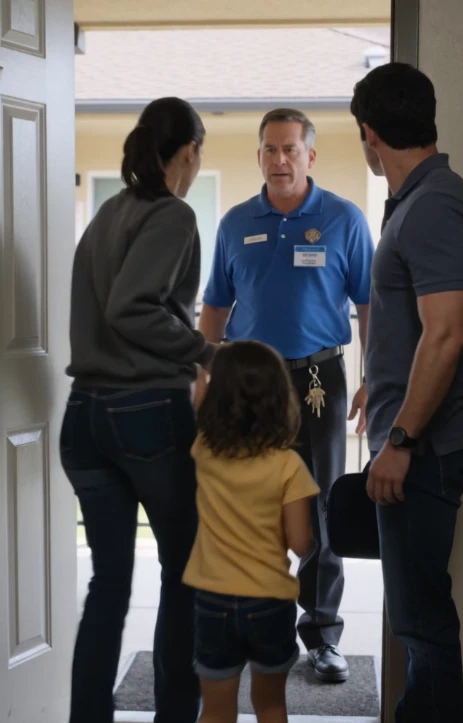
As if summoned, a man came around the corner.
Blue polo shirt.
Keys clipped to his belt.
His name tag read:
MARTIN — GENERAL MANAGER.
“What’s going on?”
The woman answered immediately.
“Guest is harassing me.”
I pointed at the girl.
“She has a four-year-old cleaning rooms.”
Martin looked irritated at first.
Then his eyes landed on the child.
And everything about him changed.
He stared.
The girl stared at the carpet.
Martin moved closer.
“Sweetheart?”
The woman stepped between them.
“We’re done here.”
Martin didn’t move.
He was studying the girl’s face.
Her left cheek.
Her hairline.
Then he whispered:
“Wait.”
The woman grabbed the child’s hand.
“She’s my daughter. We’re leaving.”
Martin stepped in front of the stairwell.
“Don’t.”
“Excuse me?”
“I know that face.”
For the first time, the woman looked nervous.
Martin pointed toward the office at the end of the breezeway.
“There’s a missing-child flyer behind my desk.”
She laughed.
Too loudly.
“You think every brown-haired child is the same?”
Martin shook his head.
“No.”
His voice had changed.
“It’s the mark above her eyebrow.”
I looked.
A tiny crescent-shaped scar was visible beneath the child’s bangs.
Martin swallowed.
“The flyer specifically mentions it.”
The woman pulled harder on the girl’s hand.
“We’re leaving.”
Then Martin said:
“Her picture is on the missing-person flyer in my office.”
The woman stopped.
Not because she was shocked.
Because she was calculating.
She looked toward the stairs.
Then toward the parking lot.
Then at Martin’s radio.
I saw every glance.
So did he.
He lifted the radio.
“Front desk, lock the lobby doors and call 911.”
The woman bolted.
She didn’t get far.
Not because anyone tackled her.
Because the little girl didn’t run with her.
The woman yanked once.
Hard.
The child dropped to the floor.
For a split second, the woman had to decide whether to stop and pick her up or run alone.
She chose alone.
She let go and sprinted down the outdoor staircase.
Martin shouted into the radio.
I dropped beside the girl.
“Are you okay?”
She crawled backward against the motel room door.
Her eyes were enormous.
“Don’t.”
“I’m not going to touch you.”
“She comes back.”
“Who?”
The girl stared toward the stairs.
The woman disappeared around the building.
“She always comes back.”
Martin was already on the phone with police.
I crouched several feet away.
“What’s your name?”
No answer.
“Do you know that woman’s name?”
The girl’s bottom lip trembled.
I expected “Mom.”
Instead she whispered:
“Miss Carla.”
Martin stopped speaking into the phone.
I looked at him.
“Carla?”
The girl nodded.
“What does Mommy call her?”
The child looked confused.
Martin lowered the phone.
“Sweetheart… is Carla your mommy?”
She shook her head.
Once.
Then harder.
“No.”
That single word made the hallway feel cold.
Police found Carla fifteen minutes later hiding behind a dumpster at a gas station across the highway.
She gave them a different name first.
Then another.
Neither matched the identification in her purse.
Her real name was Carla Voss.
She was not the child’s mother.
Not her aunt.
Not a relative.
Not a legal guardian.
The little girl’s real name was Sophie Ramirez.
She had disappeared eleven months earlier.
I learned that later.
That afternoon, all we knew was what Martin pulled from the corkboard behind the front desk.
A photocopied flyer.
MISSING CHILD: SOPHIA “SOPHIE” RAMIREZ, AGE 4.
She had been three when she vanished.
Last seen at a county fair nearly six hundred miles away.
Brown eyes.
Dark brown hair.
Small crescent scar above left eyebrow.
One front tooth slightly chipped.
On the flyer was a photograph of a smiling little girl wearing a red sweater.
The child sitting in Martin’s office barely resembled her.
Not because her face had changed.
Because everything inside it had.
The smiling child in the flyer looked directly at the camera.
The girl beside me watched doors.
She watched hands.
She watched voices.
Every movement mattered.
Martin placed the flyer face down.
“I don’t want her seeing this yet.”
A police officer named Harris sat near the door.
A female detective was on the way.
Sophie had been given juice and crackers.
She ate the crackers first.
Quickly.
Too quickly.
Then she took two more and pushed them into her pockets.
Nobody stopped her.
After the third one, she looked at me.
“Can I keep?”
“Yes.”
“For later?”
“Yes.”
She stared as though waiting for the trick.
“There’ll be more later too.”
She didn’t believe me.
But she kept eating.
Detective Lena Ortiz arrived just before seven.
She did something that impressed me immediately.
She took off her badge.
Not because she was hiding who she was.
Because Sophie kept staring at it.
Ortiz put it on the desk where the child could see it but not feel threatened by it.
Then she sat on the floor.
“Hi, Sophie.”
The girl stopped chewing.
“You know my name?”
“Yes.”
“Carla says it’s Anna.”
Ortiz’s expression didn’t change.
“What name do you like?”
The girl thought.
“Sophie.”
“Okay. Sophie.”
A little of the tension left her shoulders.
Ortiz pointed toward the flyer.
“Do you remember this picture?”
Sophie looked.
For a long time.
Then touched her own red sweater in the photograph.
“Grandma sweater.”
Ortiz glanced at Harris.
“Do you remember Grandma?”
Sophie nodded.
“Grandma has birds.”
“What kind?”
“Blue ones.”
Ortiz smiled.
The missing-person file said Sophie’s maternal grandmother kept parakeets.
That was the first confirmation beyond appearance.
Then Ortiz asked:
“Do you remember Mommy?”
Sophie’s face crumpled.
She whispered:
“Mommy cried.”
“When?”
“Before car.”
“Whose car?”
“Carla car.”
“Was Carla there?”
A nod.
“Who else?”
Sophie froze.
Her eyes went to the office door.
Ortiz noticed.
“You don’t have to tell me.”
Sophie leaned toward me.
I still don’t know why she trusted me.
Maybe because I gave her the first cracker she was allowed to keep.
Maybe because I had challenged Carla.
Sometimes children decide safety using things adults can’t see.
She whispered:
“Man.”
Ortiz’s voice stayed calm.
“What man?”
Sophie pressed her mouth against my sleeve.
“The man from rooms.”
Martin frowned.
“What rooms?”
Sophie pointed toward the hallway.
“Motel rooms?”
Ortiz asked.
Sophie nodded.
Then said something none of us understood at first.
“Other girls clean too.”
Nobody moved.
Ortiz leaned forward.
“What other girls?”
Sophie immediately shut down.
Her face emptied.
“Sweetheart?”
No response.
“Where are they?”
Sophie pulled her knees into her chest.
Then whispered:
“Yellow house.”
Carla had worked at Pine Crest for only nineteen days.
She was hired through a housekeeping subcontractor called BrightWay Staffing.
Her paperwork looked legitimate.
Background check cleared.
References answered.
According to motel records, Carla had never declared a dependent or asked permission to bring a child to work.
Martin believed Sophie first appeared about a week earlier.
Not openly.
A guest had complained that towels were missing and said he saw “a kid running behind the housekeeping cart.”
Another employee assumed it was a guest’s child.
A maintenance worker saw Sophie carrying pillowcases down a stairwell.
Carla said her babysitter had canceled.
Nobody reported it.
Nobody connected it to the flyer.
The flyer itself had been hanging in Martin’s office for more than eight months.
He kept missing-child flyers because his own younger sister had disappeared briefly as a teenager decades earlier.
Most employees barely noticed them.
Martin did.
And that afternoon, a tiny crescent scar turned a photocopy into a living child.
But Sophie’s words changed the investigation from a recovery to a search.
Other girls clean too.
Yellow house.
Detective Ortiz asked Carla about the yellow house.
Carla said Sophie was making things up.
Then investigators searched Carla’s phone.
They found photographs.
Children carrying laundry.
Children sweeping floors.
Pictures taken in motel rooms across three states.
Some faces were blurred by motion.
Others were clear enough to identify.
Not every child was missing.
Some belonged to women working illegally who had been threatened with losing their children if they did not cooperate.
Two children, however, matched active missing-person reports.
The case widened overnight.
Police traced BrightWay Staffing.
The company existed.
Technically.
Its registered address was a mailbox.
Its listed owner had died two years earlier.
Payroll records led to prepaid cards.
The cards led to motels.
The motels led to a man named Everett Sloan.
When Sophie had whispered “the man from rooms,” investigators initially thought she meant someone at Pine Crest.
She didn’t.
She meant Sloan.
He visited motels where BrightWay supplied workers.
He collected cash.
Moved employees.
Moved children.
And according to federal investigators, he knew exactly how vulnerable people became invisible in places built around constant turnover.
Housekeeping staff enter rooms unnoticed.
I thought that was strange until Elena explained.
Leave a Reply