
The small fox was struggling to find a clear way along the river when a coyote suddenly appeared nearby.
The young animal remained close to the water while the coyote watched from the surrounding area, creating an uncertain moment in the natural landscape.
What happened next depended on how carefully the animals responded to one another.
The riverbank offered limited room for the fox to move, with water on one side and uneven ground along the other.
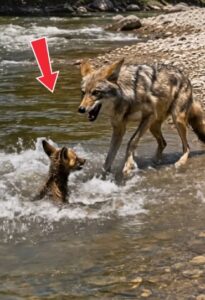
The coyote remained interested in the smaller animal, occasionally adjusting its position while keeping its attention focused nearby.
For anyone watching, the scene was a reminder of how quickly an ordinary wildlife setting can become unpredictable.
Rivers and streams provide important habitats for many species, including foxes, coyotes, birds, and smaller mammals.
Animals often visit these areas to find water, search for food, or travel between different parts of their territory.
Because several species may depend on the same environment, unexpected encounters are a natural part of life in the wild.
The fox moved carefully along the riverbank, appearing to search for a safer route.
Its movements were limited by the terrain, but it continued looking around rather than remaining in one place. The coyote stayed nearby, observing the fox and the surrounding landscape.
Anyone who noticed such a scene would need to remain at a safe distance.
Approaching either animal could cause a sudden reaction, particularly because wild animals may become more alert when people enter their space.
The safest response would be to observe quietly and contact wildlife professionals if the fox appeared genuinely unable to move.
The fox continued shifting its position while the coyote remained nearby.
Every movement seemed to attract the coyote’s attention, making the encounter difficult to predict. At the same time, the river gave the fox a natural boundary that influenced where it could safely go.
A nearby passerby might have wondered whether the fox needed assistance.
However, wild animals can sometimes appear vulnerable while simply resting or deciding where to travel.
Before attempting to intervene, it is important to determine whether the animal is actually in need of help and whether approaching would create additional risks.
The coyote eventually moved closer to the riverbank, keeping its attention on the fox.
The smaller animal responded by remaining alert and looking for an open route.
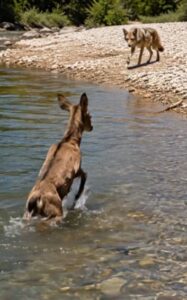
Their behavior showed the importance of awareness in the wild, where animals constantly assess their surroundings and respond to changing conditions.
Rather than trying to interfere directly, a responsible observer would give both animals enough space.
If the fox truly could not reach a safe area, trained wildlife responders could assess the situation and determine the most appropriate action.
Keeping people, pets, and vehicles away from the riverbank would also help reduce unnecessary stress.
As the moment continued, the fox appeared to find a possible route along the edge of the river.
The coyote remained in the area but did not need to be confronted. Allowing the animals to create their own distance was the safest approach.
The scene also highlights the importance of understanding wildlife behavior.
Coyotes are adaptable animals that can live in many different environments, including areas close to human communities.
https://twitter.com/i/status/2090412177609871441
Leave a Reply