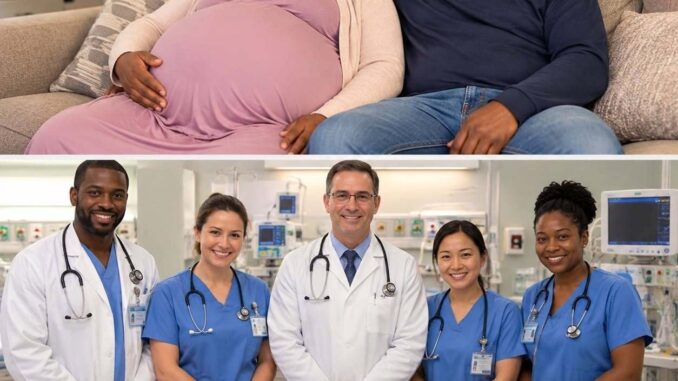
A reported birth involving ten babies has drawn enormous attention online, not only because of the extraordinary number of newborns, but also because of the medical complexity such a pregnancy would involve.
Multiple pregnancies are already considered high risk compared with a typical single-baby pregnancy. When the number of fetuses rises dramatically, the challenges can become far more serious for both the mother and the babies.
According to the account surrounding this story, what began as an unusually complicated pregnancy eventually turned into a delivery that surprised even the medical team involved.
The reported arrival of a tenth baby became the detail that transformed an already remarkable birth into a story shared across social media and news-style websites around the world.
An Extremely Unusual Pregnancy
Pregnancies involving several babies require much closer medical supervision.
Doctors generally need to monitor the mother’s health while also following the development of each fetus as carefully as possible.
That can involve repeated imaging, measurements of fetal growth, checks on blood pressure, monitoring for anemia, and observation for complications that can become more common in high-risk pregnancies.
For the family at the center of this account, the months leading up to delivery were reportedly filled with constant medical appointments and preparation.
The excitement of expecting several children would naturally exist alongside serious concern about what could happen during the pregnancy and delivery.
Unlike a routine pregnancy, a case involving an unusually high number of babies requires preparation for many possible outcomes.
Why Delivering Multiple Babies Is So Complicated
The delivery of several newborns at once can require a large team.
Obstetricians may work together with anesthesiologists, neonatal specialists, nurses, respiratory professionals, and other medical staff.
The reason is simple.
Each baby may need attention immediately after birth.
One newborn may begin breathing normally without assistance, while another may require respiratory support or additional monitoring.
Another may need help maintaining body temperature.
At the same time, the medical team must continue closely monitoring the mother’s condition.
When several infants are born within a short period, everything needs to happen quickly and in an organized way.
In a reported delivery involving ten babies, the logistical demands would be extraordinary.
The Moment the Delivery Began
According to the story, the medical team had already prepared for an unusually difficult birth.
As the delivery began, each newborn had to be evaluated immediately.
One baby arrived.
Then another.
Then another.
For the medical staff, every birth represented a new patient who needed individual attention.
For the parents, the experience must have been almost impossible to process in real time.
Instead of waiting to meet one child, they were reportedly watching their family expand again and again within the same delivery.
The emotional pressure alone would have been immense.

Then Came the Unexpected Twist
The most dramatic detail in the account came after several babies had already been delivered.
According to the story, the team believed the delivery was nearly complete.
Then another baby was discovered.
A tenth newborn reportedly arrived, surprising those present in the room.
That detail quickly became the focus of the story.
The account suggested that the additional fetus may not have been clearly identified during earlier prenatal examinations.
However, claims like this require caution.
Without independent confirmation from the hospital, treating physicians, or documented medical records, the precise explanation cannot be established with certainty.
Can a Baby Go Undetected During Pregnancy?
Modern ultrasound technology provides doctors with a large amount of information during pregnancy, but imaging is not perfect.
Visibility can be affected by several factors, including fetal position, gestational age, the number of fetuses, maternal anatomy, and technical limitations during an examination.
In especially complicated multiple pregnancies, identifying and following every fetus can become more challenging.
That does not mean that an undetected baby is common.
It would be highly unusual.
But highly unusual medical stories are exactly why extraordinary claims need strong documentation before being treated as established fact.
The Risks of High-Order Multiple Pregnancies
Pregnancies involving several fetuses can create significant medical risks.
Doctors may monitor more closely for problems such as:
- Premature delivery
- High blood pressure
- Gestational diabetes
- Anemia
- Placental complications
- Differences in fetal growth
- Low birth weight
- Delivery-related complications
Prematurity is one of the major concerns in pregnancies involving multiple babies.
Newborns delivered early may need specialized care, including respiratory support, temperature control, feeding assistance, or extended time in a neonatal intensive care unit.
For that reason, the delivery itself is only one part of the medical challenge.
Every Baby Becomes an Individual Patient
One of the most difficult aspects of a large multiple birth is that the medical team must care for several newborns separately.
Even when babies are born only minutes apart, they may have very different medical needs.
One infant may be stable.
Another may need additional oxygen.
Another may require closer monitoring.
At the same time, the mother’s condition must remain a priority.
This is why coordination between medical teams matters so much during complex births.
Doctors and nurses need to communicate constantly and clearly while making rapid decisions.
The Parents Face an Entirely Different Reality
Once the delivery is over, the family’s challenges are only beginning.
Caring for ten babies would require a level of organization that few families ever experience.
Think about the ordinary needs of one newborn:
Feeding.
Sleeping.
Clothing.
Diapers.
Medical appointments.
Comfort.
Constant supervision.
Now multiply those responsibilities many times over.
The emotional joy of welcoming new children would also come with enormous physical and financial demands.
Support Becomes Essential
Families dealing with very large multiple births may need support from many different sources.
That can include relatives, friends, charities, community organizations, medical professionals, and social services.
Practical needs may include:
- Baby supplies
- Transportation
- Housing
- Medical expenses
- Childcare assistance
- Feeding support
- Clothing
- Household help
- Long-term education expenses
The amount of work required to care for several newborns at once can be overwhelming even for a well-prepared family.
Support networks can therefore become just as important as medical care after the family leaves the hospital.
Why Stories Like This Spread So Quickly
Extremely rare birth stories naturally attract attention.
People are fascinated by events that fall far outside everyday experience.
A reported birth involving ten babies combines several elements that make a story highly shareable:
It is emotional.
It is unusual.
It involves medicine.
It raises questions people immediately want answered.
How could so many babies develop at once?
Were they all healthy?
How did doctors prepare?
Could one really have gone undetected?
Those questions are understandable.
But they also highlight why responsible reporting matters.
Extraordinary Claims Need Extraordinary Verification
When a story involves a rare medical event, it is important to separate what has been reported from what has been independently confirmed.
The number of babies involved, their health status, the condition of the mother, and any explanation about an undetected fetus are all medical claims.
Ideally, those details should be supported by a hospital statement, medical documentation, or reliable reporting based on named healthcare professionals.
A viral post, image, or secondhand account alone is not enough to establish the full medical story.
That does not make the story meaningless.
It simply means readers should remain cautious about dramatic details that cannot be independently verified.
A Reminder About Prenatal Care
Whatever the final verified details of this particular case, the story points toward something important.
Regular prenatal care plays a critical role in monitoring pregnancy.
Appointments give healthcare professionals the opportunity to track fetal development, monitor the mother’s health, identify complications, and prepare for delivery.
This becomes even more important in high-risk pregnancies.
No test can guarantee that every possible complication will be predicted in advance.
Pregnancy can change quickly.
That is why ongoing medical supervision is so valuable.
The Delivery Is Only the First Chapter
For a family welcoming several children at once, the story does not end when the babies are born.
That is when another challenge begins.
There may be weeks or months of medical monitoring.
There may be feeding difficulties.
There may be developmental follow-ups.
There will be countless sleepless nights.
There will also be milestones, first smiles, first words, birthdays, personalities, friendships, and eventually completely different lives unfolding side by side.
Each child will grow into an individual person with unique interests, strengths, and dreams.
More Than an Astonishing Number
It is easy for headlines to focus only on the number ten.
But behind that number are real people.
A mother facing a demanding pregnancy.
Parents trying to understand a dramatic change in their family.
Doctors and nurses managing a highly complex medical situation.
And several newborns who may require very different levels of care.
That human side of the story matters more than the shock value of the headline.
Medicine Is Advanced, but Not Perfect
Prenatal medicine has progressed enormously.
Ultrasound imaging, neonatal intensive care, fetal monitoring, and maternal medicine allow doctors to manage pregnancies that would have been far more dangerous in the past.
Still, medicine has limits.
Rare cases can create situations that are difficult to predict.
Human biology does not always follow a simple pattern.
That uncertainty is one reason high-risk pregnancies require experienced medical teams and careful monitoring.
An Extraordinary Beginning
The reported birth of ten babies remains remarkable because of the scale of the event and the questions surrounding it.
The story touches on pregnancy, neonatal care, medical technology, family resilience, and the limits of prediction.
But once the headlines disappear, what remains is something much more personal.
A family must care for its children.
Doctors must continue monitoring those who need medical attention.
Parents must adapt to a completely new life.
And the newborns themselves begin their own individual journeys.
A birth like this may become famous because of a number.
But the real story is what happens afterward.
It is the daily care, the recovery, the uncertainty, the support, the milestones, and the responsibility of helping every child grow.
In the end, the most extraordinary part may not be the reported arrival of ten babies.
It may be everything the family will experience together from that moment forward.
Leave a Reply