
Some photographs preserve more than a person’s appearance. They hold the atmosphere of an entire era—the fashions, the optimism, and the quiet sense that life still had countless chapters waiting to unfold.
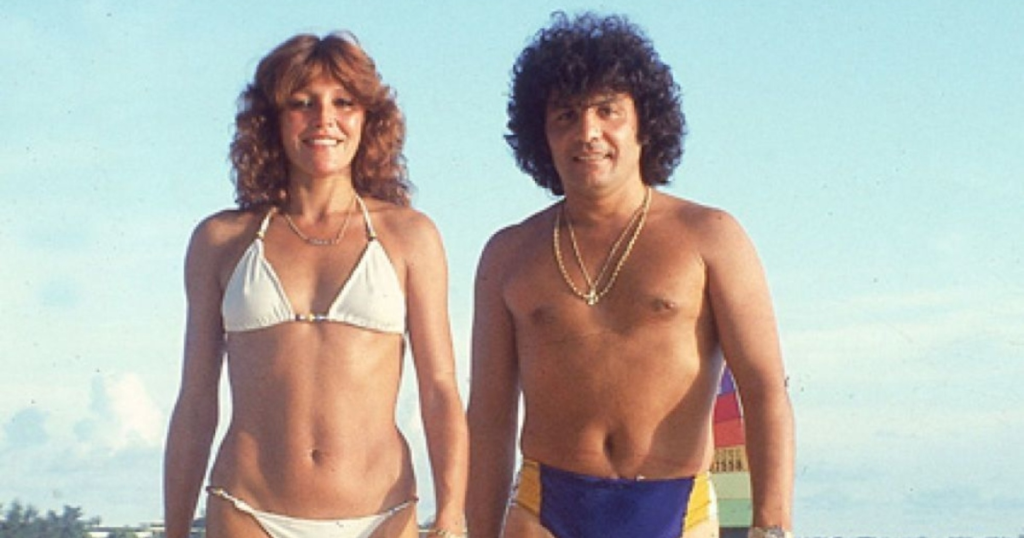
One such image shows a young Carmen Cervera walking along a peaceful shoreline beside a companion. The original article describes the photograph as dating from 1974, when she was already familiar with public attention but still years away from the cultural role that would eventually define her legacy.
A Beach Scene From a Different Time
For Americans who remember the 1970s, the photograph may bring back memories of a more relaxed kind of celebrity culture.
There were no smartphones raised above every crowd. Photographs arrived in newspapers and magazines rather than appearing instantly on a screen. A single candid image could remain unseen for weeks before finding its way into the public eye.
The beach itself looks refreshingly uncomplicated. There are no elaborate sets, dramatic poses, or carefully arranged promotional details. Carmen appears comfortable in the sunshine, smiling as she walks near the water.
Her companion stands beside her, equally relaxed. Behind them, a colorful sail adds a small splash of unmistakable 1970s charm.
The image feels less like a formal celebrity portrait and more like a page discovered in an old family album. That sense of naturalness is precisely what makes vintage photographs so compelling.
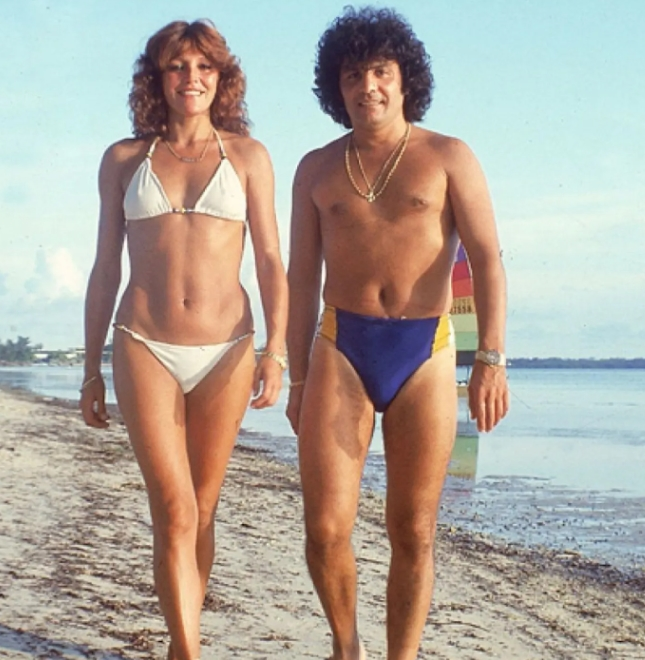
We are not merely looking at how people dressed. We are remembering how summers once felt.
Before the Museums and Masterpieces
Long before Carmen Cervera became associated with internationally celebrated art collections, she had already built a life in the public eye.
Born in Spain and widely known as Tita Cervera, she came to national attention after winning the Miss Spain title in 1961. She later worked as a model and appeared in European films, gaining an understanding of fashion, photography, and the demands of public life.
Beauty competitions held a very different cultural place during that period. For many young women, they provided one of the few direct routes into modeling, movies, travel, and international society.
Carmen’s early success introduced her to a glamorous world that seemed far removed from the quiet galleries and historic paintings that would later become central to her story.
Yet those early years may also have taught her something important: images can shape how a generation remembers its time.
A Life Connected to Old Hollywood
Carmen’s personal journey also crossed paths with the fading years of classic Hollywood.
She married American actor Lex Barker in 1965. Barker was remembered by many moviegoers for playing Tarzan and appearing in adventure films during the 1940s and 1950s. Carmen was widowed when he died in 1973.
For older audiences, Barker’s name may recall the Saturday matinees and television reruns that once brought jungle adventures into American living rooms.
Carmen’s proximity to that world gave her life a distinctly cinematic quality. She moved among actors, filmmakers, social figures, and international personalities at a time when European elegance and Hollywood glamour frequently overlapped.
The beach photograph belongs to that chapter—a period when she was known primarily for her beauty, her social presence, and her connections to entertainment.
The most important part of her public life, however, was still ahead.
The Marriage That Opened a New Chapter
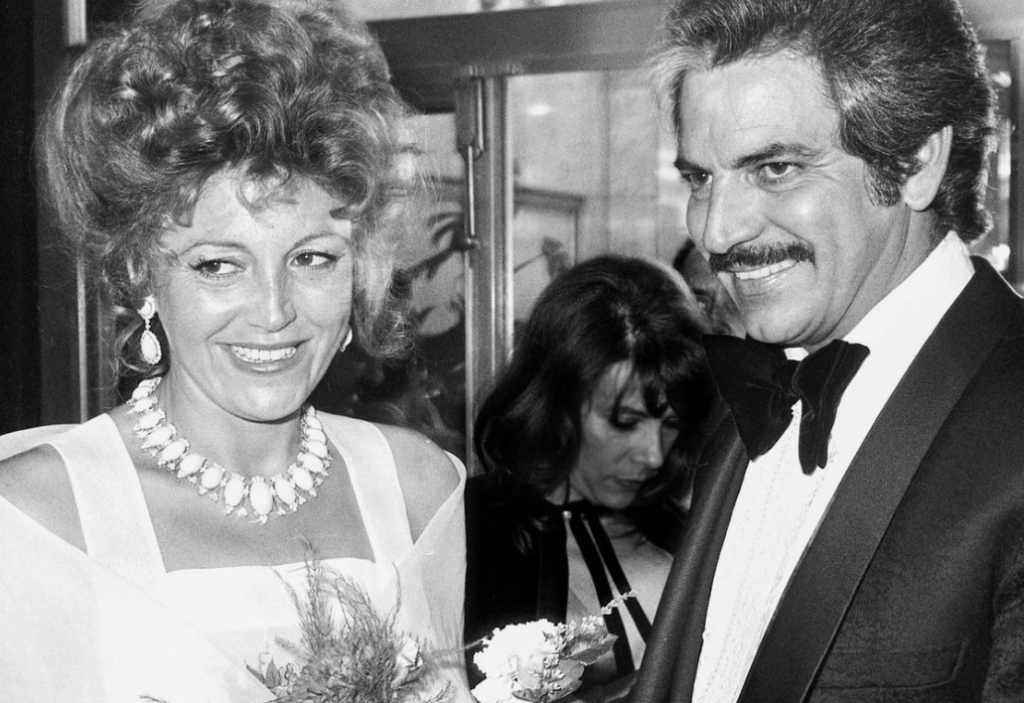
In 1985, Carmen married Baron Hans Heinrich Thyssen-Bornemisza, an industrialist and one of the most prominent private art collectors of his generation.
Their partnership gradually moved Carmen’s public identity away from movie premieres and society photographs and toward art preservation, museum development, and cultural stewardship.
In 1988, the Baron and Carmen reached an agreement with the Spanish government to exhibit hundreds of works from the Thyssen collection. The Thyssen-Bornemisza Museum opened in Madrid in 1992, and the Spanish state acquired the core collection the following year.
The transformation was remarkable.
The young woman once photographed on beaches and red carpets became closely involved with the future of paintings by some of the most significant artists in European and American history.
From the Subject of Photographs to a Guardian of Art
There is a poetic contrast between Carmen’s early career and her later achievements.
As a young woman, she was frequently the subject being photographed. Cameras recorded her clothes, her relationships, and her appearances at fashionable destinations.
Later, her attention shifted toward protecting the work of artists who had recorded their own worlds on canvas.
The Carmen Thyssen Collection now includes works spanning several centuries, from 17th-century Dutch painting through Impressionism, Post-Impressionism, and major developments in 20th-century art. Artists represented include Canaletto, Monet, Renoir, Degas, Gauguin, Rodin, Matisse, Picasso, and others.
In 2022, an agreement ensured that 330 works from her collection would remain at Madrid’s Thyssen-Bornemisza National Museum for 15 years, allowing the public to continue experiencing them together.

This is the part of her story that gives the old beach photograph unexpected depth.
The smiling young woman could not have known exactly where life would take her. She could not have seen the galleries, negotiations, exhibitions, and cultural responsibilities waiting in the distance.
Like all of us in our younger photographs, she was standing at the beginning of chapters that had not yet been written.
Why Vintage Photographs Continue to Move Us
Old celebrity photographs attract attention partly because they reveal familiar public figures before their lives became part of history.
But their appeal goes deeper than curiosity.
They remind us of our own younger years.
A hairstyle may recall a sister getting ready for a summer party. A beach may bring back a long-ago family vacation. A colorful sail might awaken memories of postcards purchased from a seaside gift shop.
Even the grain and faded colors of the photograph feel comforting. They belong to a time when pictures were printed, placed in envelopes, and carefully saved in drawers.
Looking at Carmen’s beach photograph today, viewers may see glamour. They may also see youth, possibility, and the universal uncertainty of not yet knowing what life will become.

An Enduring Presence
Carmen Cervera’s later photographs show a woman who remained connected to the public world while embracing a far more substantial cultural mission.
The setting changed from beaches to galleries. The cameras remained, but they now documented exhibitions, museum events, and a collection intended to be shared with future generations.
Her journey is a reminder that a public image never tells the complete story.
The young woman in the sunlit photograph was once celebrated for her appearance and social presence. Decades later, her most lasting association would be with paintings, museums, and the preservation of artistic heritage.
Perhaps that is why the picture remains so memorable.
It captures not only a woman on a beach, but also a life before its greatest transformation—a quiet moment from the past, glowing with all the promise of what had yet to come.
Leave a Reply