When my mother’s will was read, I expected to feel emotional.
I didn’t expect to feel forgotten.
My family had gathered in the small office of the lawyer who had handled my mother’s affairs. Everyone was quiet at first, still processing the fact that she was gone.
My mother had lived a long life.
She had collected many things over the years, and everyone knew there would be difficult decisions about who would receive what.
The lawyer began reading the will.
My older brother was left the family house.
My sister received some jewelry and a collection of photographs.
Another relative was given my mother’s car.
There were savings accounts, furniture, keepsakes, and other possessions.
Then the lawyer paused.
He looked at me.
“Your mother left this specifically to you.”
He reached into a box beside his desk.
I expected to see a piece of jewelry.
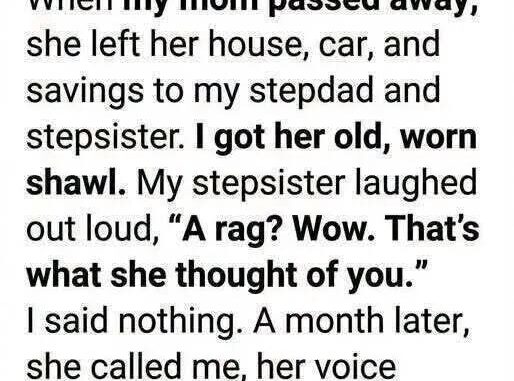
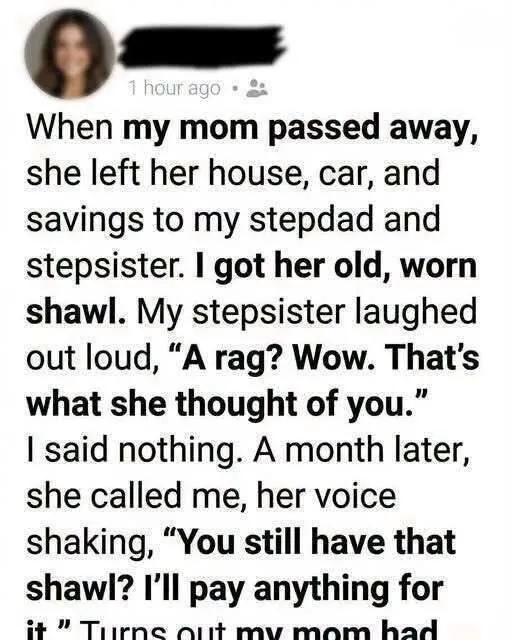
Instead, he handed me an old shawl.
I stared at it.
It was faded and worn.
The edges were frayed, and the fabric had clearly been used for many years.
I recognized it immediately.
My mother had owned it for as long as I could remember.
She wore it around the house during chilly evenings. She carried it when she traveled. Sometimes I even remembered seeing it folded over the back of her favorite chair.
But compared with everything else in the will, it seemed almost insignificant.
My sister Lila looked at it and laughed.
“That’s what you got?”
Someone else smiled.
I tried to smile too.
But inside, I felt a strange disappointment.
Not because I wanted the house or the jewelry.
I simply wondered why my mother had chosen this one old piece of fabric for me.
The lawyer noticed my expression.
Then he said something that made me stop.
“Your mother was very specific about this.”
I looked at him.
“What do you mean?”
He opened the folder again.
“She instructed me to tell you not to throw it away.”
My sister stopped laughing.
“Why?”
The lawyer shook his head.
“She didn’t explain.”
That answer stayed with me.
The Shawl Came Home With Me
That evening, I took the shawl home.
I placed it on my kitchen table and examined it carefully.
At first, I found nothing unusual.
It smelled faintly of the cedar closet where my mother used to store winter clothes.
The fabric was soft from years of use.
There were tiny stains and loose threads.
I ran my fingers along the edge.
Then I noticed something.
One section felt thicker than the rest.
I turned the shawl over.
There was a line of stitching that didn’t seem to match the original pattern.
It was subtle enough that I might never have noticed it if I hadn’t been looking closely.
I found a small pair of scissors and carefully examined the stitching.
I didn’t want to damage my mother’s belongings, so I stopped.
Instead, I called my sister.
“Lila, do you remember anything unusual about this shawl?”
She laughed again.
“You’re still investigating that old thing?”
“Just answer me.”
There was a pause.
“No.”
Then she added:
“Actually… wait.”
“What?”
“I remember Mama telling me once that you would understand someday.”
My heart skipped.
“She said that?”
“Yes. I didn’t know what she meant.”
Neither did I.
A Memory From Childhood
That night, I started remembering things I hadn’t thought about in years.
My mother had always been protective of the shawl.
When we were children, she didn’t allow us to use it as a blanket or drag it across the floor.
Once, when I was about ten, I accidentally spilled something on it.
My mother became unusually upset.
Not angry.
Just frightened.
She immediately took the shawl away and examined it.
At the time, I thought she was simply worried about ruining an old favorite.
Now I wasn’t so sure.
The next morning, I called my mother’s closest friend.
Her name was Nora.
She had known my mother for more than fifty years.
When I mentioned the shawl, she became quiet.
“You still have it?”
“Yes.”
“Your mother never told you?”
“Told me what?”
Nora sighed.
“She wanted to tell you herself.”
My heart began beating faster.
“What was she going to tell me?”
“I don’t know everything.”
“Then what do you know?”
Nora told me that the shawl had belonged to my grandmother.
My mother had received it when she was a young woman.
But that wasn’t the interesting part.
According to Nora, my grandmother had used the shawl during one of the most difficult periods of her life.
She had kept it for decades.
Then she gave it to my mother with one instruction:
“Keep this until the right person asks about it.”
I stared at the shawl.
“Did she ever explain what that meant?”
“No.”
The Hidden Pocket
Later that afternoon, I decided to take another careful look.
This time, I noticed something along the inside edge.
A small opening had been sewn shut.
It wasn’t part of the original design.
My hands trembled as I examined it.
I carefully opened the stitches.
Inside was a tiny folded piece of fabric.
And inside that fabric was a photograph.
It was old and slightly faded.
I recognized my mother immediately.
She was much younger.
Maybe twenty-five.
Standing beside her was a man I didn’t recognize.
On the back of the photograph was a handwritten message:
“For the day she finally asks.”
I called Lila.
She came over immediately.
We sat at the kitchen table and stared at the photograph.
“Who is that man?” she asked.
“I don’t know.”
We searched through my mother’s old albums.
Nothing.
Then Lila remembered something.
“There’s a box in the attic.”
We climbed upstairs.
After nearly an hour of searching, we found it.
Inside were old letters, photographs, and documents.
One photograph showed my mother standing beside the same man.
This time, there was another person in the picture.
My grandmother.
Lila looked at me.
“This wasn’t just a random photograph.”
I agreed.
But we still didn’t know the story.
The Letter
At the bottom of the box was an envelope.
My name was written on it.
I recognized my mother’s handwriting.
My hands shook as I opened it.
The letter was short.
My dear daughter,
If you are reading this, then you have the shawl.
I know you may wonder why I left you something that looks so ordinary.
Some of the most important things in our family were never expensive.
That shawl carried memories through three generations.
It was with your grandmother during a difficult time. It was with me when I needed courage. And I wanted it to be with you because I believe you will understand what it represents.
I stopped reading.
For a moment, I thought that was the whole mystery.
Then I turned the page.
There was another paragraph.
There is no treasure hidden inside it.
The treasure is the story.
I looked at Lila.
She smiled through tears.
But the letter continued.
My mother explained that the man in the photograph was someone who had helped my grandmother when the family was struggling.
He had offered assistance when they had very little.
My grandmother couldn’t repay him financially.
Instead, she gave him something more personal: a promise that his kindness would be remembered.
Years later, my mother found the photograph and the old letters again.
She kept them with the shawl.
Not because they were valuable in money.
Because they reminded her that difficult periods eventually pass—and that people can make a difference in one another’s lives without expecting anything in return.
Why She Gave It to Me
The final lines of the letter explained everything.
My mother wrote:
I could have divided every valuable thing I owned between you.
But your siblings would remember the house, the jewelry, and the money.
I wanted you to remember something different.
I wanted you to remember where we came from.
Whenever life becomes difficult, remember that this shawl survived every season before you.
It was repaired.
It faded.
It became worn.
But it remained useful.
People can be like that too.
I couldn’t hold back my tears.
Suddenly, the old shawl didn’t look worthless.
It looked like a piece of our family history.
My Sister Changed Her Mind
The next day, Lila came over.
She looked at the shawl sitting on my chair.
Then she laughed softly.
“Do you remember when I laughed at this?”
I smiled.
“Yes.”
She shook her head.
“I was wrong.”
“No,” I said. “You just didn’t know the story.”
She ran her fingers over the fabric.
“Neither did I.”
We spent the afternoon reading the old letters and looking through photographs.
There was no hidden fortune.
No secret bank account.
No valuable object sewn into the fabric.
Instead, there was something much more meaningful to us: a connection to people and moments that had almost disappeared from our family’s memory.
The Meaning of an Ordinary Object
After my mother’s death, I initially thought inheritance was about dividing possessions.
The house.
The car.
The jewelry.
The savings.
But my mother had apparently thought about inheritance differently.
She knew that objects can carry memories.
A photograph can remind you of someone.
A recipe can bring back a childhood kitchen.
A piece of furniture can remind you of a grandparent.
And sometimes, an old shawl can become a reminder of several generations of people who lived, struggled, loved, and carried on.
I still have the shawl.
I don’t wear it often.
Instead, I keep it carefully folded in a box with my mother’s letter and the old photographs.
Every now and then, I take it out.
The fabric hasn’t become more valuable with age.
But its meaning has.
And whenever someone asks me why my mother left me an old, worn shawl instead of something expensive, I tell them the truth:
She wasn’t giving me a piece of clothing.
She was giving me a piece of our family story.
Leave a Reply