
The Mysterious Light Above Ikaria May Have Had a Remarkable Natural Explanation
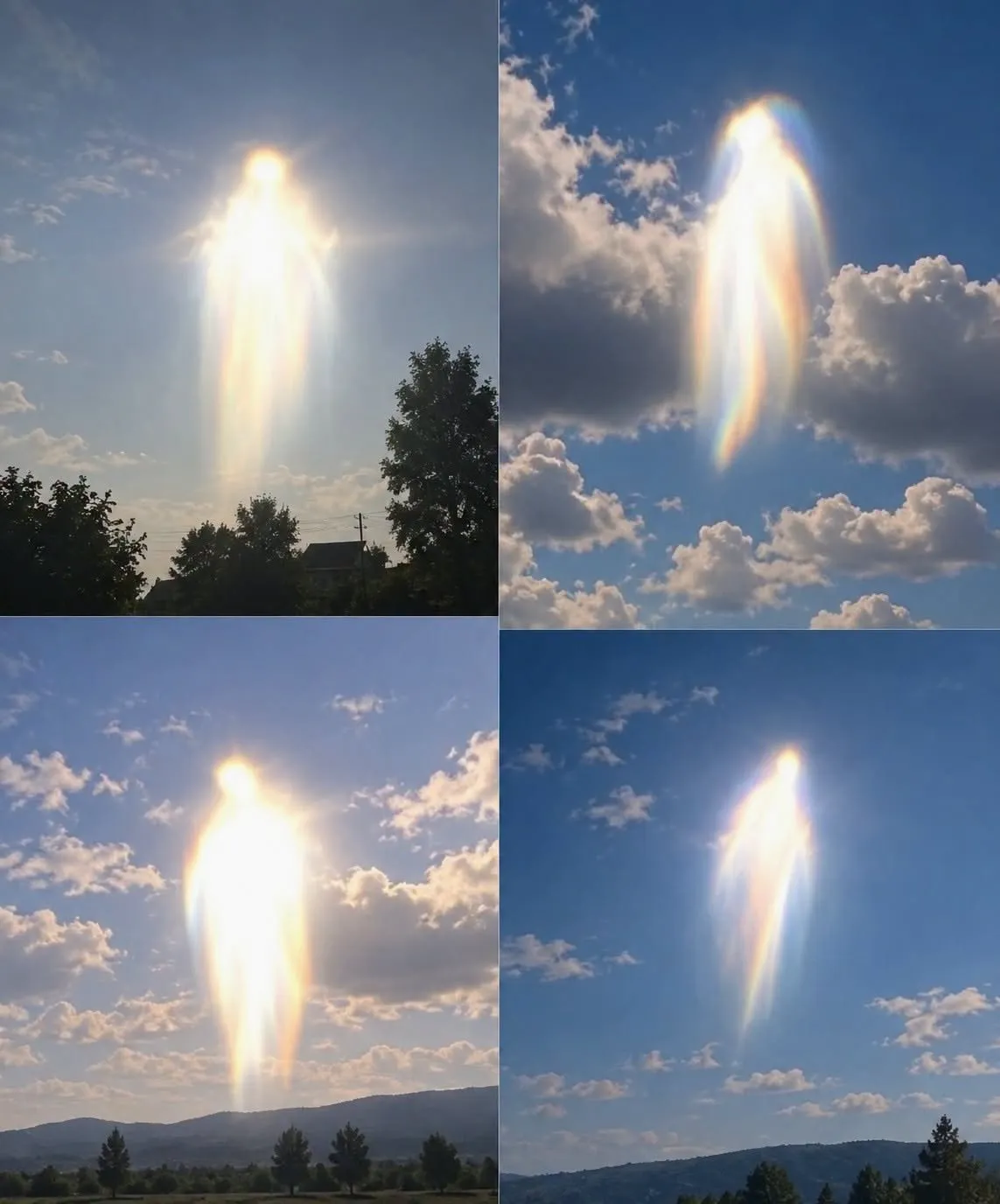
For a brief moment above the Greek island of Ikaria, the sky appeared to produce something that looked almost impossible.
A brilliant, human-like shape seemed to hang in the atmosphere, glowing intensely against the blue sky. Its elongated form appeared strangely solid, almost as though a luminous figure or mysterious object had been suspended high above the island.
It was the kind of sight that could make even a skeptical observer stop and stare.
Was it some kind of aircraft? A strange atmospheric phenomenon? An optical illusion? Or something that had simply never been seen before?
The answer may be far less mysterious—but no less fascinating.
What appeared above Ikaria can be understood as the remarkable interaction of sunlight, ice crystals, atmospheric layers, airborne particles, and human perception. Under the right conditions, ordinary elements of nature can combine to create shapes that look extraordinarily unusual.
And sometimes, the sky does not need anything supernatural to produce a scene that feels completely otherworldly.
When Light Begins to Look Like an Object
Human vision is remarkably good at finding patterns.
This ability has helped humans recognize faces, movement, animals, and potential dangers throughout evolution. But that same ability can sometimes cause us to interpret ambiguous shapes as familiar objects.
A bright patch of light can become a figure.
A vertical beam can appear to have a body.
A shifting glow can look as though it is moving with intention.
When the shape is bright enough and sharply contrasted against the surrounding sky, the impression can become surprisingly convincing.
The observer does not experience it as a collection of scattered rays of sunlight.
They experience it as something.
That distinction is important.
The physical phenomenon may be produced entirely by light and atmosphere, while the brain organizes what the eyes receive into an apparently recognizable form.
The Role of Sunlight
One of the most important ingredients in unusual atmospheric displays is the angle of the Sun.
Around sunrise and sunset, sunlight travels through a much greater distance of Earth’s atmosphere before reaching an observer.
That longer path can make atmospheric effects particularly noticeable.
Light encounters molecules, tiny particles, moisture, and—in certain conditions—ice crystals suspended in the atmosphere.
These materials can redirect, scatter, or refract sunlight.
The result can include familiar phenomena such as halos, bright pillars, glows, arcs, and other optical effects.
Under unusual viewing conditions, however, these effects can combine in ways that are much harder for the eye to interpret.
A vertical streak of light may appear almost like a column.
A bright region may stretch upward or downward.
The edges of a luminous area can become surprisingly distinct.
Against a darker portion of the sky, the contrast can make the effect appear even more solid.
Ice Crystals Can Create Extraordinary Shapes
Tiny ice crystals in the atmosphere can act almost like microscopic optical instruments.
Their shapes and orientations influence the way sunlight travels through them.
When sunlight encounters appropriately shaped ice crystals, the light can be refracted or reflected, producing luminous structures in the sky.
This is part of the physics behind several atmospheric optical phenomena.
A particularly striking example is a sun pillar, in which vertically aligned or plate-like ice crystals can create an elongated column of light appearing above or below the Sun.
Depending on the atmospheric conditions and the observer’s position, such effects can look remarkably dramatic.
The light does not necessarily represent a physical object occupying the space where it appears to be.
Instead, it is an optical pattern created by the interaction between sunlight and crystals suspended in the atmosphere.
The Atmosphere Is Never Completely Uniform
Another important factor is that Earth’s atmosphere is constantly changing.
Air near the surface can have a different temperature and density from air above it.
Different layers can move at different speeds and contain different amounts of moisture and particles.
These variations can affect the way light travels.
Over the ocean, this effect can become particularly interesting because the surface of the sea and the air immediately above it can have significant temperature differences.
Warm and cool layers may exist close together, creating conditions in which light from distant objects becomes distorted.
This phenomenon is associated with atmospheric refraction and can sometimes produce mirages or unusual apparent positions.
An object can appear higher, lower, stretched, compressed, or otherwise displaced from where it actually is.
The result can be deeply confusing to an observer.
Why the Sea Makes the Illusion Even More Striking
Ikaria’s location provides a dramatic natural setting for atmospheric optical phenomena.
The island is surrounded by the Aegean Sea, giving observers broad, unobstructed views toward the horizon.
That matters because a clear horizon provides a strong visual reference.
When an unusual light appears against an open sky, there are few nearby objects with which the eye can compare its size or distance.
A bright shape can therefore appear much more substantial than it actually is.
The absence of buildings or nearby objects can make it difficult to judge perspective.
A distant phenomenon may look close.
A relatively small optical effect may appear enormous.
And a light source whose actual position is difficult to determine may seem to hover somewhere between the sky and the horizon.
When Atmospheric Layers Distort What We See
Atmospheric refraction is capable of producing some remarkably strange visual effects.
When light travels through air with different temperatures and densities, its path can bend slightly.
Normally, these changes are too subtle to notice.
Under certain conditions, however, the effect becomes obvious.
This can produce mirages in which distant objects appear to float, stretch, or become distorted.
The famous “floating” appearance of distant ships or landforms can sometimes be explained by these variations in atmospheric density.
The same basic principle helps explain why something seen over water may appear to occupy a position that does not correspond exactly to its physical location.
What the eye receives is real light.
But the apparent location and shape of its source can be altered by the atmosphere through which that light has traveled.
The Brain Adds Another Layer to the Mystery
Physics alone does not completely explain why such an image can feel so extraordinary.
The human brain is constantly interpreting visual information.
Most of the time, this happens so quickly that we never notice it.
We see a chair and immediately recognize it as a chair.
We see a person’s face and instantly identify its basic features.
We see an animal-shaped silhouette and begin interpreting it before consciously analyzing every detail.
The same process occurs when we encounter ambiguous natural phenomena.
When an unusual bright shape appears in the sky, the brain attempts to find a familiar pattern.
If the shape resembles a person, the mind may interpret it as a figure.
If it appears to move, the movement can reinforce the impression that the shape is alive.
If the image changes gradually, the brain may interpret those changes as deliberate motion.
None of this means that the observer is imagining the light.
The phenomenon itself can be completely real.
What changes is how the brain interprets it.
Why the Shape Can Seem Almost Alive
A stationary object is relatively easy to understand.
A moving or changing shape is different.
Atmospheric light can shimmer as air density changes. Clouds can alter the amount of light reaching the observer. Ice crystals can shift position. The apparent edges of a luminous area can expand or contract.
To the human eye, those subtle changes can resemble movement.
And movement is strongly associated with living things.
If a bright shape appears to change position or form, the brain naturally searches for an explanation.
It may seem as though the object is moving intentionally.
But the movement may actually come from changing atmospheric conditions and changing illumination.
The light does not need to have a destination.
The atmosphere itself can create the appearance of motion.
A Familiar Psychological Phenomenon
There is a broader psychological concept behind this tendency: pareidolia.
Pareidolia occurs when people perceive familiar patterns in ambiguous or random stimuli.
Seeing a face in a cloud is a simple example.
People may also recognize familiar shapes in shadows, rocks, reflections, or patterns of light.
This tendency is not a sign that something is wrong with the observer.
It is a normal feature of human perception.
Our brains are designed to extract meaning from incomplete information.
In the case of a strange light in the sky, the combination of brightness, contrast, movement, and an ambiguous outline can create a particularly powerful example of this phenomenon.
The viewer may genuinely feel that they saw a figure.
The optical effect can be real.
The interpretation can simply be different from the physical mechanism producing it.
Why the Image Feels So Convincing
Several factors can work together to create a remarkably convincing illusion.
Brightness
A very bright source can overwhelm surrounding visual details, making the shape’s edges difficult to interpret.
Contrast
A bright object against a darker blue sky can appear sharply defined.
Distance
Without familiar objects nearby, judging distance becomes difficult.
Atmospheric distortion
Different layers of air can alter the apparent shape and location of light.
Movement
Small changes can make a static optical phenomenon appear dynamic.
Pattern recognition
The brain naturally tries to convert ambiguous shapes into recognizable forms.
Together, these factors can create an image that looks almost impossible.
The Extraordinary Can Come From Ordinary Ingredients
Perhaps the most fascinating part of the phenomenon is that none of its individual ingredients needs to be extraordinary.
Sunlight is ordinary.
Air is ordinary.
Water vapor is ordinary.
Ice crystals are ordinary.
Tiny particles in the atmosphere are ordinary.
The human visual system is ordinary.
But when all of these elements interact under particular conditions, the result can be anything but ordinary.
This is one of the most beautiful aspects of atmospheric science.
Nature does not always need rare materials or dramatic events to create spectacular effects.
Sometimes, the right combination of ordinary conditions is enough.
Why the Sky Over Islands Can Be Especially Fascinating
Islands and coastal regions can provide ideal environments for unusual visual effects because they combine large bodies of water, changing air temperatures, strong sunlight, and expansive horizons.
The sea constantly exchanges heat with the atmosphere.
Winds move different air masses across the surface.
Humidity varies throughout the day.
Clouds form and dissipate.
Sunlight changes angle from morning to evening.
All of these factors influence what an observer sees.
A person standing on an island with a wide view of the horizon may therefore witness atmospheric phenomena that are difficult to reproduce or predict precisely.
The scene may last only minutes.
Sometimes it may change before anyone has time to understand what they are seeing.
Understanding the Science Doesn’t Make It Less Beautiful
There is a tendency to think that explaining a mystery makes it less magical.
But atmospheric optics offers the opposite lesson.
Learning that ice crystals can transform sunlight into brilliant pillars does not make the phenomenon boring.
Learning that temperature differences can bend light does not make a mirage less beautiful.
And understanding that the brain recognizes familiar shapes does not make the original experience less emotionally powerful.
In many ways, the scientific explanation makes the event even more impressive.
It reveals how complex the natural world is.
A phenomenon that initially looks impossible can turn out to be a demonstration of real physical processes operating together in a precise and beautiful way.
No Aliens Are Necessary to Make the Sky Look Otherworldly
When people encounter unexplained lights, the imagination can quickly move toward extraordinary explanations.
That is understandable.
Humans have always looked toward the sky and wondered what might exist beyond what they can see.
But an unusual appearance is not automatically evidence of something extraterrestrial or supernatural.
In this case, atmospheric optics, light refraction, ice crystals, airborne particles, and perception provide a much more grounded framework for understanding how a strange luminous shape could appear.
That does not mean every unexplained light has the same explanation.
It simply means that an extraordinary appearance is not, by itself, evidence of an extraordinary cause.
A Reminder That Our Eyes Don’t Show Us the Entire Story
What we see is the final product of a long chain of events.
Light leaves a source.
It travels through the atmosphere.
It interacts with particles, moisture, and different layers of air.
It eventually reaches our eyes.
The eyes send signals to the brain.
The brain then constructs the visual experience we consciously perceive.
At every stage, conditions can influence the final image.
That is why two people standing in nearly the same place can sometimes describe an unusual atmospheric phenomenon differently.
They are receiving similar information, but their brains are interpreting subtle visual details in slightly different ways.
The Mystery Above Ikaria
Whether the particular image associated with Ikaria represents a specific documented atmospheric event would require independent verification of the photograph, location, date, weather conditions, and original source.
But the general phenomenon described is firmly grounded in a fascinating reality:
The atmosphere can manipulate light in extraordinary ways.
Under the right combination of sunlight, ice crystals, particles, temperature layers, and viewing conditions, the sky can produce shapes that appear to hover, stretch, glow, or even resemble familiar forms.
And once the human brain encounters those shapes, it does what it has evolved to do.
It searches for meaning.
A glow becomes a figure.
A shifting edge becomes movement.
A strange silhouette becomes something that appears almost alive.
Sometimes Nature Is Strange Enough
The most captivating thing about unusual sky phenomena is that they remind us how little control we have over the appearance of the natural world.
The same Sun that rises every morning can produce dramatically different visual effects depending on atmospheric conditions.
The same ocean that looks calm from the shore can create layers of air capable of bending light.
The same clouds that seem ordinary can suddenly become part of an optical display that looks almost impossible.
And the same human brain that helps us understand the world can sometimes turn ambiguous light into something deeply familiar.
So the mysterious figure above Ikaria does not necessarily need to be explained by something from beyond our world.
Sometimes, sunlight, ice, air, water, and perception are more than enough.
What looks like a visitor from another world may simply be a fleeting conversation between light and atmosphere—a rare moment when ordinary physics creates an extraordinary illusion.
And perhaps that is the real wonder.
The sky does not have to contain aliens, spacecraft, or supernatural beings to make us stop and stare. Sometimes, the natural world is already strange enough.
Leave a Reply