
For those who remember Hollywood in the 1970s, 1980s, and early 1990s, certain faces carry an entire era with them.
They bring back memories of neighborhood movie theaters, Friday-night television, glossy entertainment magazines, and films that seemed to remain part of the conversation long after the final credits rolled.
The woman in these candid beach photographs belongs to that generation of stars.
Her distinctive voice, expressive eyes, and vulnerable screen presence helped make her one of the most recognizable actresses of her time. Yet in these pictures, she is far removed from studio lights, carefully arranged costumes, and glamorous premieres.
She is simply walking beside the ocean, allowing the warm sun and Pacific breeze to set the pace of her day.
A Quiet Afternoon on the Mexican Coast
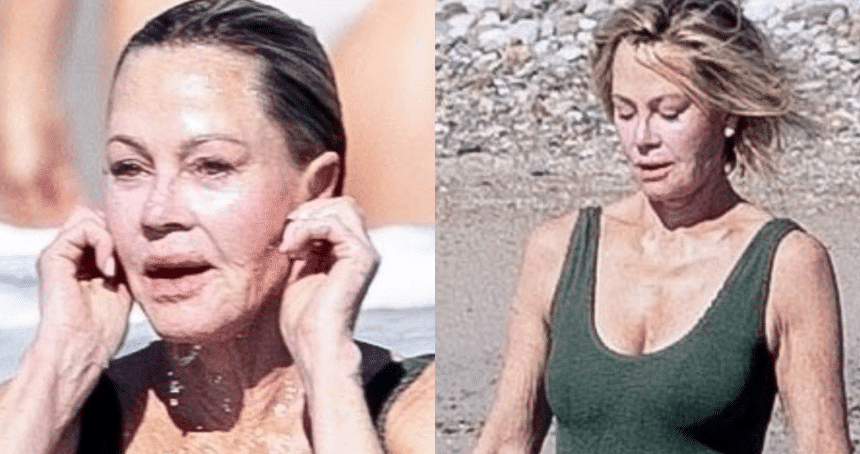
The photographs were taken during a January 2024 visit to Puerto Vallarta, Mexico.
Dressed in a simple forest-green one-piece swimsuit, the actress walked barefoot along the shoreline and spent time cooling off in the water. There was no elaborate styling and no formal pose created for publicity.
The setting appeared peaceful and refreshingly ordinary.

Although the images resurfaced in 2026, she was 66 when the beach outing occurred. Contemporary coverage identified the location as Puerto Vallarta and described her as enjoying a relaxed Monday beside the sea.
There is something timeless about such a scene.
No matter how famous a person becomes, a beach has a way of simplifying life. The ocean does not ask about box-office numbers, awards, reviews, or headlines. It offers the same rolling waves and open horizon to everyone.
For a woman who has spent most of her life being photographed, judged, and discussed, the quietness of the moment feels especially meaningful.
The Actress Behind the Photographs
The woman walking across the sand is Melanie Griffith.
Born in New York City in 1957, Griffith entered the entertainment world at a young age. She is the daughter of actress Tippi Hedren, the unforgettable star of Alfred Hitchcock’s The Birds and Marnie. Griffith therefore grew up close to the glamour of classic Hollywood, but she also witnessed the pressures that could exist behind its polished public image.
By the mid-1970s, Griffith had begun establishing a career of her own.
She appeared in Arthur Penn’s Night Moves and later earned wider attention through films including Brian De Palma’s Body Double and Jonathan Demme’s Something Wild. Her performances often combined confidence with emotional openness, making her characters feel less predictable than many conventional Hollywood heroines.
But one particular role transformed her into a household name.
The Movie That Defined a Hollywood Era

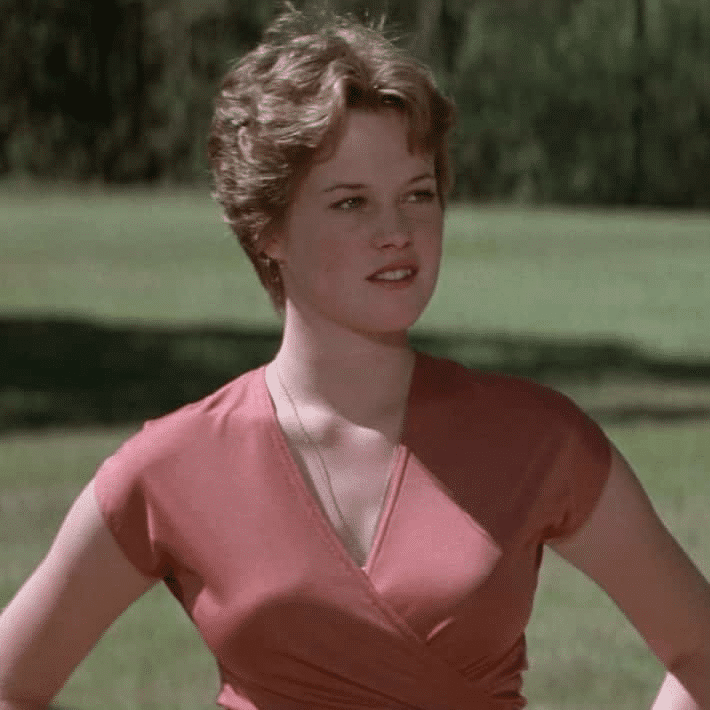
In 1988, Griffith starred as Tess McGill in Working Girl.
For many moviegoers, Tess remains impossible to forget.
She was a Staten Island secretary with ambition, intelligence, and an idea that deserved to be heard. Surrounded by powerful executives who underestimated her, she found the courage to step beyond the role others had assigned to her.
The film arrived at a moment when American workplaces were changing and more women were challenging long-established expectations. Tess was imperfect, determined, funny, and hopeful.
She wanted a career, but she also wanted respect.
Her journey resonated with audiences who had experienced the frustration of being overlooked despite having something valuable to contribute.
Griffith’s performance won the Golden Globe for Best Actress in a Motion Picture, Musical or Comedy. It also earned her an Academy Award nomination for Best Actress. The film itself received five Oscar nominations and won for Carly Simon’s original song “Let the River Run.”
For viewers who first saw the film in theaters, the opening images of commuters crossing New York Harbor may still stir a feeling of possibility.
Tess McGill represented a familiar American belief: a person should not be defined permanently by where she begins.
Why Audiences Remembered Her
Melanie Griffith’s screen appeal was never based solely on conventional glamour.
She could certainly look every inch the movie star, but her performances often carried a sense of vulnerability. Her characters seemed to be thinking and feeling beneath the surface, even when they were trying to appear confident.
Her speaking voice was immediately recognizable.

So was the way she could shift between humor, uncertainty, determination, and tenderness within the same scene.
In Something Wild, she brought energy and unpredictability to a story that moved between comedy and danger. In Working Girl, she made an ambitious secretary both relatable and heroic. In films such as Pacific Heights, she moved comfortably into darker and more suspenseful territory. These roles helped establish a career that could not be reduced to a single type of character.
That versatility matters when looking back at her legacy.
Hollywood has always been quick to create labels, especially for women. An actress may be called an ingénue, a beauty, a romantic lead, or a supporting player, as though one description should define an entire working life.
Griffith repeatedly stepped beyond those narrow categories.
Growing Up in the Public Eye
It is difficult to imagine what it means to spend nearly an entire lifetime surrounded by cameras.
Most people have the freedom to change privately.
They can experiment with new styles, reconsider old decisions, experience personal difficulties, and move into new stages of life without strangers documenting every detail.
Famous women are rarely granted that privacy.
Their appearances are compared across decades. Ordinary changes are treated as public events, while photographs taken during vacations or errands may be examined as though they were official portraits.
Griffith has experienced that kind of attention since she was young.
That history gives the beach photographs a deeper significance. They are not remarkable because she is attempting to resemble the woman audiences remember from 1988.
They are remarkable because she appears to have no need to perform for anyone.
She is not dressed as Tess McGill or arriving as a guest at an awards ceremony. She is enjoying the sun as herself.
A Hollywood Family Across Generations
Griffith’s family story connects several eras of American entertainment.
Her mother, Tippi Hedren, became an enduring figure of 1960s cinema. Griffith later built her own career during the changing film culture of the 1970s and 1980s.
The family’s connection to Hollywood continued through Griffith’s daughter Dakota Johnson, whom she shares with actor Don Johnson. Griffith is also the mother of son Alexander Bauer and daughter Stella Banderas. Her family life has connected her to actors Steven Bauer and Antonio Banderas as well.
Yet Griffith has spoken about maintaining warm relationships across this extended family.
In 2020, she described the fathers of her children as friends and expressed her continuing affection for them. More recently, Antonio Banderas publicly referred to Griffith as his lifelong friend while sharing a family reunion with their daughter Stella and Stella’s husband.
That may be one of the quieter accomplishments of her later life.
Families do not always follow a simple or traditional path. Relationships change, marriages end, and children grow into adults with lives of their own.
Remaining connected requires patience, forgiveness, and the willingness to let a family evolve.
The Lasting Appeal of a Seaside Escape
For generations of Americans, a beach vacation has represented more than travel.
It is often associated with slowing down.
The days are measured by sunlight rather than appointments. Shoes become optional. Meals are simpler. Conversations last longer because no one is rushing toward the next obligation.
Older adults may appreciate that change of rhythm more than anyone.
After decades of schedules and responsibilities, there can be great pleasure in an afternoon that demands nothing more than walking beside the water.
Puerto Vallarta, with its Pacific coastline and warm climate, has long attracted travelers looking for that kind of escape. But the emotional appeal of these images does not depend entirely on the destination.
The same feeling can be found beside a quiet lake, on a shaded porch, in a familiar garden, or during a morning walk through a neighborhood one has known for years.
Peace is not always dramatic.
Sometimes it arrives when a person finally stops trying to impress the world.
From the Shoreline Back to the Spotlight
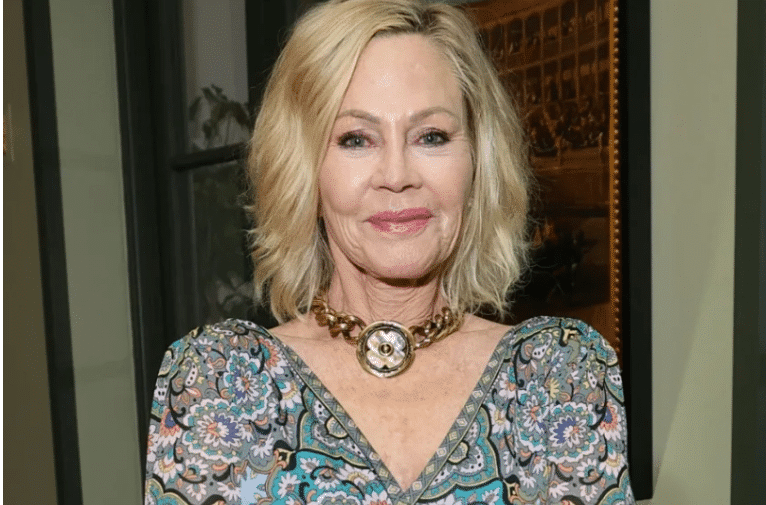
The final image presents Melanie Griffith in a setting more commonly associated with her public life.
Her blonde hair is carefully styled. She wears a patterned dress and a bold necklace, looking directly toward the camera with the familiar poise of a seasoned performer.
The contrast between this portrait and the beach photographs is striking.
One shows the actress prepared for a public appearance.
The others show a woman spending an uncomplicated day near the ocean.
Neither image is more authentic than the other. Both belong to her life.
A person can enjoy dressing elegantly for a special occasion and still value the freedom of walking barefoot on the sand. Growing older does not require choosing between glamour and simplicity.
There is room for both.
A Gentle Reminder From a Familiar Face
Melanie Griffith’s career will always be connected to memorable performances, particularly the hopeful determination she brought to Working Girl.
But a lasting legacy is not built only through awards and famous roles.
It is also shaped by endurance.
She has moved through several generations of Hollywood, experienced enormous public attention, raised a family, and continued entering new chapters without allowing one period of her life to define all the others.
The photographs from Puerto Vallarta preserve one small chapter.
They show no dramatic performance and reveal no great Hollywood secret. Instead, they offer something more comforting: a familiar actress appearing peaceful within her own life.
For viewers who have grown older alongside her, that may be the most nostalgic part of all.
The young secretary from Working Girl once looked toward the Manhattan skyline and imagined a future filled with possibility.
Decades later, the woman who played her stood beside another wide horizon.
This time, she did not appear to be searching for anything.
She simply seemed happy to be there.
Leave a Reply