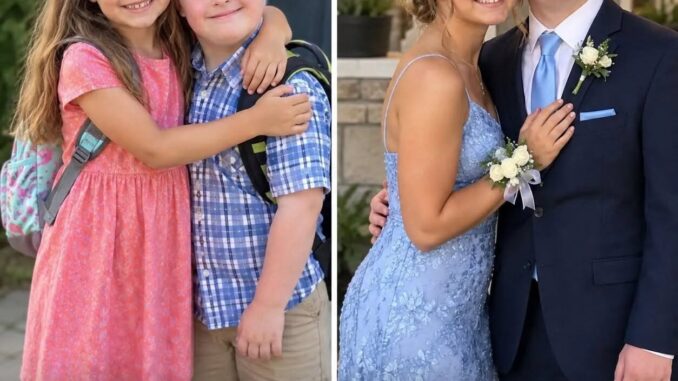

On Prom Night, My Mother Locked My Bedroom Door — Then She Told Me the Truth About My Best Friend
On prom night, my mother locked my bedroom door.
That was the moment I realized something was wrong.
Downstairs, Noah was waiting for me.
I could hear his voice drifting up through the floorboards, followed by my aunt’s laughter. He had arrived in the navy suit he had been talking about for months, wearing the bow tie he had bought absurdly early because, according to him, stores could not be trusted to keep important things in stock.
I should have been downstairs with him.
Instead, I was standing in my bedroom while my mother turned the lock behind us.
“Mom?”
She looked at me with an expression I couldn’t read.
“You can go with Noah tonight, Christina,” she said.
I folded my arms.
“But first, I need you to hear something.”
“About what?”
For a moment, she didn’t answer.
Her eyes moved toward the closed door.
Then she looked back at me.
“About Noah.”
My stomach tightened.
And then she added, much more quietly:
“And about me.”
Suddenly, prom was the last thing on my mind.
A Friendship That Started With Raisins
Noah and I had been best friends since we were six years old.
There was no dramatic beginning to our friendship. No movie-worthy introduction. No teacher intentionally putting us together because she somehow knew we would become inseparable.
It started because we both hated raisins.
Our first-grade teacher had handed everyone a little red box of raisins during snack time.
I didn’t want to eat mine, but I was also six years old and deeply concerned about getting in trouble for wasting food. So I developed what I believed was an ingenious strategy: I quietly pushed the raisins underneath my napkin.
Then I heard a voice beside me.
“That’s smart.”
I turned.
Noah was doing exactly the same thing.
“You hate them too?” I whispered.
He nodded solemnly.
“They’re old grapes.”
I considered this.
It was flawless six-year-old logic.
And that was enough.
By lunchtime, we were sitting together.
By the end of the week, we were inseparable.
Noah had Down syndrome, although at six years old that fact meant much less to me than the things I actually cared about.
He laughed loudly at my terrible drawings.
He knew an unreasonable number of facts about dinosaurs.
He sometimes cheated during dinosaur trivia and then insisted he had merely “remembered faster.”
He hated raisins.
I liked him.
Childhood friendships can be beautifully uncomplicated that way.
We didn’t analyze why we were friends.
We simply were.
The Promise We Made at Six
One afternoon, another boy in our class said something cruel to Noah.
I don’t remember what started the conversation, but I remember the words.
“Nobody is ever going to marry you.”
Noah’s expression changed immediately.
Even at six, I understood enough to know that the comment had hurt him.
“Somebody will love him,” I snapped.
The other boy laughed.
“Then you marry him.”
The argument ended soon afterward, but Noah didn’t forget it.
Later, he found me by myself.
“Chrissy?”
“What?”
He looked unusually serious.
“Would you love me?”
At six years old, I had absolutely no understanding of how complicated that question might sound to an adult.
To me, love meant sitting together at lunch, sharing crayons, arguing about dinosaurs, and knowing which snacks the other person hated.
So I shrugged.
“Maybe.”
His face immediately brightened.
Then another thought occurred to me.
My older cousin had recently been talking endlessly about something called prom. From what I understood, it was an extremely important dance attended by people who were nearly adults.
“But first,” I told Noah, “we have to go to prom.”
He blinked.
“What’s prom?”
“A dance you go to when you’re almost grown up.”
He thought about that for several seconds.
Then he held out his pinkie.
“Promise?”
I hooked mine around his.
“Promise.”
And then, being six years old, I forgot about it almost immediately.
Noah didn’t.
Twelve Years of Growing Up Together
Our friendship survived the things that often pull childhood friends apart.
Different classes.
Different interests.
New friends.
Teenage embarrassment.
Arguments.
Changing personalities.
The strange, uncomfortable process of growing up.
Noah became obsessed with baseball statistics.
I became obsessed with art.
He could spend twenty minutes explaining why a particular pitcher’s numbers were historically significant.
I could spend the same amount of time staring at one painting in a museum.
He dragged me through endless conversations about baseball.
I dragged him through galleries and museums.
Neither of us successfully converted the other.
But we kept showing up.
And as we grew older, I began to understand something important about Noah.
He wasn’t the kind of person who tried to solve your problems.
He stayed beside you while you solved them yourself.
I didn’t fully appreciate how rare that was until my parents divorced.
When My Family Fell Apart
I was twelve when Dad moved out.
Until then, I had believed my family was permanent in the same unquestioning way children believe their house will always be their house.
Then suddenly there were arguments behind closed doors.
There were boxes.
There were uncomfortable conversations.
There were nights when Mom thought I was asleep and cried in the kitchen.
Dad moved away, and everything familiar seemed to shift.
I became quieter.
At school, I stopped eating much at lunch.
Sometimes I sat staring at my food while everyone around me talked.
I didn’t know how to explain what I was feeling.
Part of me was angry.
Part of me was embarrassed.
Mostly, I was afraid that if I started talking about everything happening at home, I wouldn’t be able to stop.
Noah noticed.
But he never interrogated me.
He never demanded that I tell him what was wrong.
He simply sat down beside me.
Some days he talked about baseball.
Some days he complained about homework.
Some days he said almost nothing.
He just stayed.
At the time, I didn’t understand how much those quiet lunches mattered.
Years later, I would.
The Person Who Always Showed Up
Noah had a talent for appearing during the moments when I felt most defeated.
When I failed my first driving test, I was humiliated.
Almost everyone I knew seemed to have passed immediately, and I had managed to make enough mistakes that even the examiner looked relieved when the test ended.
That afternoon, Noah showed up carrying two ice creams.
“One because you tried,” he announced.
I took one.
“And the other?”
He smiled.
“Because you drove terribly.”
I threw a napkin at him.
He ate the second ice cream.
Another time, I nearly quit art.
Someone had laughed at one of my paintings, and because I was a teenager, one careless comment felt like a final judgment on everything I would ever create.
I told Noah I was done.
The next day, I discovered that he had stolen one of the ugliest dinosaur drawings I had ever made and taped it inside his locker.
It was from elementary school.
The dinosaur had tiny arms, enormous feet, and something that looked suspiciously like a potato for a body.
“Why would you put that there?” I demanded.
“Because you can’t quit yet.”
“Why?”
He studied the picture carefully.
“Because your dinosaurs still look like potatoes with arms.”
I laughed despite myself.
That was Noah.
He rarely gave speeches.
He didn’t pretend everything would magically become better.
He simply had a way of making difficult moments feel survivable.
When my first serious teenage relationship ended, he sat with me on the porch while I cried.
He didn’t tell me the boy wasn’t worth it.
He didn’t promise I would meet somebody better.
After a while, he simply asked:
“Do you want me to insult him?”
I laughed.
“No.”
“Okay.”
A minute passed.
“I have several insults ready.”
And somehow, I laughed again.
PART 2 — The Night Everything Changed
By senior year, prom was approaching.
I already knew who I wanted to go with.
But Noah apparently believed our childhood agreement required formal enforcement.
One afternoon, he appeared beside my locker.
“Do you remember first grade?”
I looked at him suspiciously.
“That depends.”
“Raisins.”
I smiled.
Then, just to tease him, I pretended not to understand.
His face fell.
For approximately two seconds.
Then he held out his pinkie.
And suddenly the memory came rushing back.
The raisins.
The dinosaur arguments.
The cruel boy in our class.
The promise made between two six-year-olds who barely understood what prom was.
“Prom?” I asked.
“Prom.”
I hooked my pinkie around his.
Then he smiled proudly.
“I already bought the bow tie.”
“When?”
“November.”
I stared at him.
“Noah, prom is months away.”
“Stores run out of things.”
“They were not going to run out of bow ties.”
He gave me a serious look.
“You don’t know that.”
And just like that, a twelve-year-old promise became real.
The Rosemary Corsage
On prom night, Noah arrived at our house carrying a corsage.
I was halfway down the stairs when Mom opened the front door.
I watched her expression change.
Noah stood on the porch wearing his navy suit. His bow tie—the apparently endangered bow tie he had wisely secured months earlier—was perfectly straight.
In his hand was a corsage.
When he gave it to me, I examined the greenery tucked among the flowers.
“What is that?”
“Rosemary,” Noah said.
“Why rosemary?”
“The florist said it means remembering.”
He grinned.
“And I remember promises.”
Behind me, Mom made a small sound.
I turned around.
Her eyes were wet.
“Mom?”
She quickly looked away.
Then she said:
“Christina, come upstairs with me.”
“What? Why?”
“Please.”
“Noah’s waiting.”
“I know.”
Something in her voice stopped me from arguing.
I followed her upstairs.
We entered my bedroom.
Mom closed the door.
Then she locked it.
My excitement disappeared instantly.
“You’re scaring me.”
She turned around.
“You can go with Noah. But before you do, I need one promise from you.”
I felt anger rise immediately.
“If this has anything to do with Noah having Down syndrome—”
“It doesn’t.”
“Then what is this about?”
Mom sat on the edge of my bed.
For several seconds, she seemed unable to decide where to begin.
Then she asked:
“Do you remember when your father left?”
I frowned.
“Of course.”
“You were twelve.”
“I know.”
She looked down at her hands.
“You stopped eating lunch.”
My arms slowly dropped to my sides.
“How do you know that?”
She looked at me.
“Noah told me.”
The Secret My Mother Had Kept for Six Years
I didn’t understand.
Mom explained that during the worst months of the divorce, she had once been sitting alone in her car in the school parking lot.
She had been crying.
She thought nobody could see her.
But Noah had.
“He came over to me,” she said.
I sat beside her.
“What did he say?”
Mom swallowed.
“He asked me if you were broken.”
My throat tightened.
“Why would he ask that?”
“Because you weren’t eating. You weren’t laughing much. He said you were sitting alone more often.”
I stared at the floor.
Those lunches suddenly felt much closer than six years ago.
“What did you tell him?”
“I told him you weren’t broken.”
Mom reached for my hand.
“And then Noah said something I’ve remembered ever since.”
“What?”
Tears appeared in her eyes again.
“He said, ‘Good. Because I don’t know how to fix people. I only know how to stay.’”
I couldn’t answer.
For a moment, I was twelve again.
I could see the cafeteria.
The untouched food.
The empty feeling in my stomach.
And Noah sliding into the seat beside me.
Sometimes talking.
Sometimes silent.
Never demanding anything.
Never asking me to become cheerful so he could feel useful.
He had simply stayed.
The Promise I Never Knew About
Mom continued.
“That day, I asked Noah to promise me something.”
“What?”
“I asked him to look after you.”
I stared at her.
“You did what?”
“I was desperate, Christina.”
Her voice cracked.
“Your father was gone. You barely spoke to me. I felt like I was losing you too. And Noah was one of the only people who could still make you smile.”
“What did he say?”
She gave a tiny laugh through her tears.
“He said, ‘Okay.’”
Of course he did.
But then Mom’s expression changed.
“There’s something else I need to admit.”
I waited.
“For years afterward, I made a mistake.”
“What mistake?”
“Whenever you defended Noah, whenever you changed plans because someone excluded him, whenever you chose to spend time with him instead of doing something else, part of me worried.”
“Worried about what?”
“That you were giving up too much.”
I stared at her.
She continued before I could respond.
“I kept seeing the ways you helped him. I kept wondering what he might need from you in the future. I convinced myself I was protecting you.”
Her eyes dropped.
“But I wasn’t seeing your friendship clearly.”
The room became very quiet.
“I was so focused on what Noah might need from you,” she said, “that I never stopped to notice everything he gives you.”
And suddenly, I saw the last twelve years differently too.
The ice cream after my driving test.
The ridiculous dinosaur drawing in his locker.
The porch after my heartbreak.
The quiet lunches after Dad left.
The hundreds of ordinary moments nobody else would ever know about.
Noah had never been a responsibility I carried.
We carried each other.
“So what’s your condition?” I finally asked.
Mom looked confused.
“You said I could go if I made you a promise.”
She smiled.
Then she took both my hands.
“Don’t go to prom because six-year-old Chrissy made a promise.”
I waited.
“Go because eighteen-year-old Christina chooses him.”
I felt myself smile.
“Mom, that’s already why I’m going.”
Her face crumpled slightly.
“I know that now.”
PART 3 — The Promise We Chose to Keep
When Mom and I finally returned downstairs, Noah was waiting exactly where we had left him.
He looked from me to Mom.
“You took a long time.”
Mom walked directly toward him.
“Noah, can I have the first dance?”
His eyebrows rose.
“Mrs. Jane, this isn’t prom.”
I burst out laughing.
Mom ignored him and turned on music.
For the next thirty seconds, Noah attempted to guide her around the living room while she repeatedly stepped in the wrong direction.
Finally, he stopped.
“Mrs. Jane.”
“Yes?”
“Chrissy dances better.”
Mom laughed.
“That’s why she’s your date.”
Then the humor disappeared from her face.
She looked directly at him.
“Thank you for staying.”
Noah seemed confused by the seriousness of the statement.
To him, staying had never been extraordinary.
It was simply what friends did.
He shrugged.
“She stays too.”
Mom closed her eyes for a second.
Those three words seemed to answer a question she had been carrying for six years.
Twelve Years Later
Prom itself was surprisingly ordinary.
And that was what made it perfect.
No dramatic announcement was made when we arrived.
Nobody stopped the music.
Nobody treated Noah like a symbol.
Nobody treated me like I had done something heroic by showing up with my best friend.
We were simply two eighteen-year-olds going to prom.
When the first slow song began, Noah turned toward me.
“Chrissy.”
“Yes?”
He held out his hand.
“You owe me.”
“Twelve years?”
“Twelve years.”
I took his hand.
Within approximately five seconds, he stepped directly on my shoe.
“Ow!”
“That was your fault.”
“How could that possibly be my fault?”
“Your dress is badly designed.”
“You’re terrible at dancing.”
“You knew that when you agreed.”
We started laughing.
People nearby looked at us.
We didn’t care.
And standing there under cheap decorations and flashing lights, I realized how much meaning adults can attach to moments children once understood instinctively.
When we were six, Noah had asked whether somebody could love him.
I had never thought of him as a diagnosis.
I had never thought of myself as somebody making a sacrifice.
He was simply Noah.
My friend.
The boy who hated raisins.
The boy who remembered promises.
The person who stayed.
And now we were almost adults.
The world had become more complicated.
But perhaps that part didn’t need to be.
Nobody Was Rescuing Anybody
Mom picked us up after prom.
My feet were aching, so Noah carried my heels.
He was uncomfortable in his suit, so I carried his jacket.
When we reached the car, he opened my door.
I climbed inside.
Then I leaned across the back seat and opened his.
He got in beside me.
From the driver’s seat, Mom watched us through the rearview mirror.
For years, she had looked at our friendship through the question so many people instinctively ask:
Who is taking care of whom?
That night, she finally understood that it was the wrong question.
Nobody was rescuing anybody.
Nobody was staying because of guilt.
Nobody was fulfilling an obligation made years earlier.
There was no hero and no person waiting to be saved.
There were simply two friends who had grown up together.
Sometimes I carried Noah.
Sometimes Noah carried me.
Most of the time, we simply walked beside each other.
Maybe that was why our friendship had lasted.
Neither of us had been asked to become the other person’s entire world.
We simply kept making room for each other in our own.
What Noah Understood Before the Rest of Us
As we drove home, Noah eventually fell asleep against the window.
His bow tie was crooked now.
Mom glanced at him through the mirror.
Then she looked at me.
I smiled.
No words were necessary.
For six years, she had carried guilt about the promise she had asked a twelve-year-old boy to make.
She had also carried fear that I might someday confuse loyalty with obligation.
But she finally understood what Noah and I had known in our own imperfect way since childhood.
Real friendship is not measured by who needs more help.
It is not a balance sheet.
It doesn’t require every act of kindness to be immediately repaid.
There are seasons when one person gives more.
There are seasons when the other does.
There are days when friendship means showing up with two ice creams after a failed driving test.
Sometimes it means putting an ugly dinosaur drawing in your locker.
Sometimes it means sitting beside someone who cannot explain why she is hurting.
And sometimes it means remembering a promise made over boxes of unwanted raisins twelve years earlier.
Noah had said something at twelve that my mother never forgot:
“I don’t know how to fix people. I only know how to stay.”
Maybe that was the lesson underneath everything.
We spend so much of our lives trying to fix people.
We search for the right advice.
The perfect words.
The solution that will make someone stop hurting.
But often, the people we love aren’t asking us to repair them.
They simply need to know they won’t have to face the difficult part alone.
Noah understood that long before I did.
He never fixed my parents’ divorce.
He couldn’t.
He didn’t fix my failed driving test.
He didn’t erase my heartbreak.
He didn’t make every cruel comment disappear.
He simply stayed long enough for those moments to stop feeling impossible.
And I stayed for him too.
Not because my mother asked him to protect me.
Not because of the promise two children made when they were six.
Not because either of us owed the other anything.
We stayed because, somewhere between raisins and dinosaurs, school lunches and baseball statistics, paintings and heartbreaks, we had chosen each other as friends.
The prom promise mattered.
But the choice mattered more.
Noah and I had somehow figured out something as children that many adults spend years trying to understand:
Love isn’t always about fixing someone.
Sometimes it’s about sitting beside them.
Remembering what matters to them.
Carrying their shoes when their feet hurt.
Letting them carry your jacket when you’re tired.
Laughing when the dance goes wrong.
And choosing, again and again, not to disappear when life becomes difficult.
When someone truly matters to you, you stay.
And sometimes, if you’re lucky enough, they stay too.
Leave a Reply