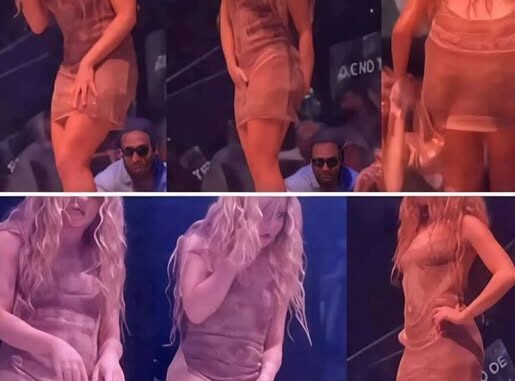
The moment Shakira leaves the stage after noticing that

Fans Applaud Shakira’s Response to Disrespectful Behavior
The Moment Shakira Walked Off Stage: What Really Happened?
Shakira has spent decades performing under some of the brightest lights in the entertainment industry. From enormous stadium concerts to award-show stages and intimate promotional appearances, the Colombian superstar is accustomed to having thousands of eyes—and countless cameras—focused on her.
But one viral moment from September 2024 was very different.
During an appearance at a Miami nightclub, Shakira suddenly appeared uncomfortable while dancing in front of the crowd. Within moments, she adjusted her clothing, gestured toward someone nearby, and eventually walked away from the stage.
Videos of the incident quickly circulated online, with reports and social media users alleging that someone in the audience had been attempting to film underneath her dress.
The short clip sparked an enormous reaction.Instead of criticizing Shakira for interrupting the performance, many viewers applauded her decision to remove herself from a situation that appeared to make her uncomfortable. For supporters, the incident wasn’t simply another celebrity moment caught on camera. It raised a much larger question about privacy, consent, boundaries, and the behavior performers should be expected to tolerate simply because they are famous.


An Unexpected Moment During a Live Performance
Shakira is known for being an exceptionally energetic performer. Dancing has always been central to her identity as an artist, and her ability to connect movement with music has become one of her signatures.
That is partly why the Miami incident attracted so much attention.
The singer was reportedly appearing at LIV nightclub in Miami while celebrating and promoting her song Soltera. Videos shared online showed her dancing on an elevated platform as people gathered closely around her.
At first, everything appeared to be part of an ordinary celebrity nightclub appearance. Shakira smiled, danced, and interacted with those around her.
Then her demeanor seemed to change.
In footage circulated on social media, Shakira could be seen looking downward toward members of the crowd. She appeared to notice something that made her uncomfortable and pulled at the bottom of her dress before continuing.
A short time later, she appeared to gesture toward the person or people in front of her, seemingly indicating that the behavior should stop.
Reports surrounding the viral clip alleged that someone had been trying to film underneath her dress. Because much of the public discussion was based on short videos and eyewitness interpretations, the precise intentions of the person involved cannot necessarily be determined from the footage alone.
What was much clearer was Shakira’s reaction.
She appeared uncomfortable, adjusted her clothing and ultimately stepped down from the platform rather than continuing to perform in the same circumstances.
That decision became the central focus of the conversation that followed.
The Video Spreads Across Social Media
In today’s entertainment landscape, an incident lasting only a few seconds can reach millions of people within hours.
That is exactly what happened here.
Clips from the nightclub began appearing across social platforms, where users replayed the moment and debated what they believed had occurred. The story was subsequently picked up by entertainment outlets and news organizations around the world.
For many viewers, the most important detail wasn’t that Shakira had stopped dancing. It was why she appeared to have done so.
The footage seemed to show a performer realizing that a boundary may have been crossed and immediately responding.
Fans argued that she had every right to stop.
A ticket, invitation, nightclub appearance, or celebrity status does not give members of an audience unrestricted permission to photograph someone however they want. The fact that a performer chooses to dance, wear a particular outfit, or appear in a crowded public venue does not eliminate their expectation of basic respect.
That point became one of the strongest themes in the online reaction.
Fans Rally Behind Shakira


The reaction from fans was overwhelmingly sympathetic.
Many people praised Shakira for refusing to remain in an environment where she appeared to feel disrespected. Rather than treating the interruption as an inconvenience, supporters framed her departure as an appropriate assertion of personal boundaries.
One idea appeared repeatedly in the discussion: fame does not cancel a person’s right to privacy.
Celebrities occupy an unusual position in modern culture. Their photographs are everywhere, their performances are recorded, and details of their lives often become public discussion. Social media has made the boundary between performer and audience even thinner.
But visibility is not the same thing as consent.
Someone agreeing to be photographed while performing does not automatically mean every angle, every moment, or every type of recording is acceptable.
This distinction seemed particularly important to the people defending Shakira.
Many argued that performers should never be expected to tolerate behavior that would be considered inappropriate if directed toward someone outside the entertainment industry.
Others noted that Shakira did not need to continue entertaining the crowd once she felt uncomfortable. Walking away was itself a legitimate response.
Why Personal Boundaries Don’t Disappear With Fame
The discussion also revealed something broader about celebrity culture.
Fans now have extraordinary access to public figures. Smartphones can record high-quality video instantly. A private-looking moment can become global content before the person being filmed even knows the video exists.
That technological reality has changed the relationship between audiences and performers.
At a concert or nightclub appearance, hundreds or thousands of cameras may be pointed toward the stage simultaneously. Most people simply want a memory of the experience. But the ease of recording can sometimes create the false impression that anything visible is automatically fair game.
It isn’t.
There remains a difference between recording a performance and deliberately trying to capture intimate or invasive footage.
For many fans, the Shakira incident illustrated exactly why that distinction matters.
Public figures may choose careers that involve enormous visibility, but they remain entitled to boundaries concerning their bodies and personal dignity.
The same principle applies far beyond celebrities.
Whether someone is performing before thousands of people, dancing at a party, commuting to work, or simply walking down the street, clothing and location should not be interpreted as permission for invasive behavior.
Shakira’s Response Was Simple—but Powerful
Part of what made the moment resonate was how little drama Shakira appeared to create around it.
There was no need for an elaborate confrontation.
Based on the widely circulated footage, she appeared to notice something, signal her discomfort, adjust her clothing and eventually leave the immediate area.
Sometimes establishing a boundary is exactly that simple.
A person does not necessarily owe an audience an explanation before removing themselves from a situation that makes them uncomfortable.
For fans, that made the moment especially relatable.
Many people have experienced situations where they suddenly realized someone was behaving in a way that felt inappropriate. In those moments, deciding whether to confront the person, ignore the behavior, seek help, or simply leave can happen almost instinctively.
Shakira’s response reminded viewers that leaving is an option.
Being professional does not mean tolerating everything.
A New Chapter in Miami
The viral incident also came during a transformative period in Shakira’s personal and professional life.
After spending years living in Barcelona, she relocated to Miami with her sons, Milan and Sasha, following her separation from former footballer Gerard Piqué.
The breakup attracted extraordinary media attention. Details surrounding their relationship were discussed extensively in entertainment media, while Shakira herself increasingly processed major changes in her life through music.
Miami represented something different.
It offered a new beginning closer to her existing connections in the United States and the Latin American entertainment community.
Professionally, Shakira entered this chapter with renewed momentum. New releases introduced her to younger audiences while longtime fans celebrated a return to the emotionally direct songwriting that had characterized much of her earlier career.
Songs released during this period frequently explored independence, heartbreak, recovery and personal reinvention.
That context inevitably influenced how some fans interpreted the nightclub incident.
To them, walking away from an uncomfortable situation seemed consistent with a larger public image Shakira had developed in recent years—one centered on resilience and reclaiming control over her own story.
Of course, a few seconds of viral footage should not be turned into a complete psychological portrait of anyone. But it is understandable why supporters connected the moment with themes already present in her music and public life.
Reinvention Has Always Been Part of Her Career
Shakira’s ability to adapt is hardly new.
Long before she became one of the world’s most recognizable Latin performers, she was a young songwriter from Barranquilla, Colombia, trying to establish her identity in the music industry.


From Barranquilla to International Stardom
Born Shakira Isabel Mebarak Ripoll in Barranquilla, Shakira demonstrated an interest in writing and performing from an early age.
Her path to superstardom wasn’t instantaneous.
Her early career included projects that failed to achieve the commercial success she would later enjoy. Rather than disappearing from the industry, she continued developing her sound and songwriting.
That persistence eventually paid off.
The 1990s became the decade in which Shakira emerged as a major Latin American star. Pies Descalzos helped introduce her distinctive combination of pop, rock and Latin influences to a much wider audience.
Then came Dónde Están los Ladrones?, an album that further established her as both a performer and songwriter.
Her international breakthrough accelerated dramatically when she crossed into the English-language market.
Rather than abandoning her Latin identity, Shakira incorporated it into a style that could travel across cultures. Her unmistakable voice, songwriting and highly recognizable dance performances helped distinguish her from other pop stars of the era.
Songs such as “Whenever, Wherever” turned her into a global household name.
More international hits followed, and her career eventually expanded to stadium performances, major awards ceremonies and some of the world’s most watched entertainment events.
Over the years, she has received major industry recognition, including Grammy Awards, numerous Latin Grammy Awards and other international honors. Her music has crossed linguistic and geographic boundaries in a way relatively few performers manage to sustain over decades.
More Than a Pop Star
Shakira’s public identity has also extended beyond entertainment.
Through philanthropic initiatives, she has long supported education and opportunities for children, particularly in Colombia.
This dimension of her career is important because it demonstrates how her influence expanded alongside her music.
As her international profile grew, so did her ability to draw attention to social issues.
For longtime fans, this combination of artist, philanthropist, mother and international celebrity has contributed to the unusually strong connection many feel toward her.
That connection helps explain why a seemingly brief nightclub incident could generate such a protective response online.
Viewers weren’t simply watching a famous singer leave a platform.
Many felt they were watching someone whose work they had followed for years encounter a situation that appeared invasive.
The Complicated Relationship Between Fans and Celebrities
The incident also highlights a contradiction at the heart of modern celebrity.
Fans often feel emotionally close to artists they admire. They know their songs, watch interviews, follow social media accounts and sometimes know extensive details about their relationships and families.
Yet that sense of familiarity remains one-sided.
Knowing a celebrity’s work—or even knowing many details about their life—does not create a personal relationship with them.
This distinction can become blurred when fans encounter famous people in person.
A smartphone makes it possible to transform an encounter into content almost immediately. Instead of simply experiencing the moment, some people may become focused on obtaining unusual footage that could attract attention online.
The incentives of social media can make this worse.
Rare, embarrassing or provocative footage may receive far more engagement than an ordinary performance video. That can encourage increasingly intrusive behavior.
The Shakira clip became an example of where many viewers believe the line should clearly be drawn.
There is nothing unusual about filming a singer performing in a nightclub where recording is permitted.
Attempting to capture invasive footage of someone’s body is a very different matter.
Clothing Is Not Consent
Another theme that emerged from the discussion was the way performers’ clothing is sometimes used to excuse inappropriate behavior.
Shakira is famous for dance-heavy performances and bold stage fashion. Neither changes the fundamental issue.
Choosing a revealing or performance-oriented outfit is not permission for someone else to disregard personal boundaries.
This is an important distinction because public conversations about incidents involving women sometimes shift attention toward what the woman was wearing rather than toward the behavior being questioned.
Supporters of Shakira strongly rejected that logic.
A performer should be able to choose clothing appropriate to her performance without accepting every possible form of photography as a consequence.
That principle applies equally outside celebrity culture.
Respect does not depend on someone’s outfit.
Why Walking Away Can Send a Strong Message
There is another reason the incident resonated.
People often associate strength with confrontation. Movies and social media frequently portray standing up for yourself as delivering the perfect response or dramatically challenging another person.
Real life is different.
Leave a Reply